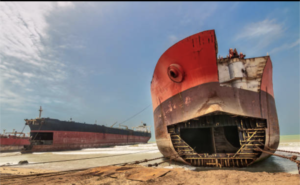

India’s ferrous scrap imports decline to 5-year low in H1CY’26 amid elevated costs, improved domestic supply

-
- Imports halve in H1CY’26 amid weaker rupee, high freights
-
- Average imported-domestic scrap price gap widens to $38/t from $12/t
-
- Mills increase DRI share in metallic mix to optimise costs
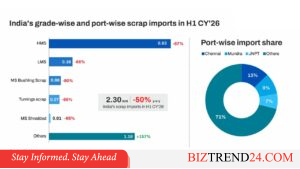
Morning Brief: India’s ferrous scrap imports fell sharply by 50% y-o-y to 2.33 million tonnes (mnt) in H1CY’26 from 4.58 mnt a year earlier, according to BigMints data. Imports dropped to their lowest level in five years, last seen during the pandemic in H1CY’21, as improving domestic scrap availability and deteriorating import economics made overseas cargoes increasingly uncompetitive for Indian steelmakers.

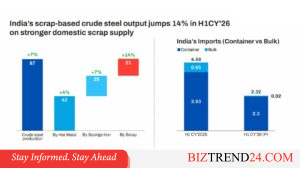
The sharp decline came despite robust growth in steelmaking. India’s crude steel production increased by over 7% y-o-y to 87 mnt, while scrap-based output grew even faster, rising 14% to 21 mnt. Total scrap consumption increased 8% to 21.1 mnt in H1CY26, with domestic scrap supplying 18.8 mnt, or nearly 90% of total demand, compared with about 80% a year earlier. The increase in domestic scrap availability largely displaced imports.
Import economics deteriorate amid Middle East conflict:
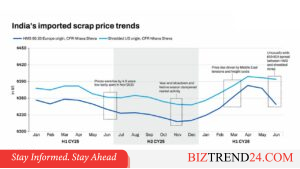
A combination of higher freight costs, a weaker rupee, and geopolitical disruptions significantly raised the landed cost of imported scrap during H1CY’26.
Escalating tensions in the Middle East disrupted shipping routes. At the same time, the Indian rupee weakened sharply against the US dollar, averaging around INR 93.47/$ during H1CY’26 compared with INR 85.86/$ a year earlier, raising the cost of all dollar-denominated scrap imports.
On average, imported HMS traded at a premium of INR 3,600/t ($38/t) over domestic scrap during H1CY’26, compared with INR 1,100/t ($12/t) in H1CY’25. The average price gap therefore widened by around INR 2,500/t ($26/t), making imported cargoes less competitive for Indian buyers.
Notably, bulk scrap imports plunged 97% y-o-y to around 20,000 t from about 0.65 mnt in H1CY’25, with only two small bulk vessels arriving during the period. This is because buyers favoured cargoes with short lead times due to global geopolitical uncertainty and volatile freights.
Higher domestic availability reduces dependence on imports:
The improvement in domestic scrap availability was equally important in reducing imports.
Higher volumes of industrial processing scrap, fabrication waste, machinery replacement, infrastructure demolition, and end-of-life vehicle scrap expanded domestic supply, allowing mills to source a larger share of their metallic requirements locally. BigMint projects domestic scrap generation to have risen to 18.8 mnt during H1CY’26 from around 15 mnt a year earlier, while imported scrap’s share of total consumption fell to about 10% from nearly 20%.
The wider availability of locally sourced material also reduced the need to import standard HMS grades, particularly for inland mills where freight from ports further eroded import competitiveness.
Mills increasingly optimise their metallic mix:
Secondary steelmakers increasingly optimised their metallic mix in favour of sponge iron (DRI) and other domestic metallics. This is because of wider availability and the lag in domestic scrap generation compared with steelmaking demand.
Domestic DRI prices, too, are not subject to global volatility as compared to scrap. For example, domestic HMS 80:20 (DAP Chennai) averaged INR 33,000/t ($345/t) during H1CY’26, up 8% from a year earlier, while sponge iron (pellet-based DRI, DAP Chennai) averaged INR 27,500/t ($288/t), an increase of only 4% y-o-y. The widening price gap made DRI a more economical metallic, particularly as domestic scrap tracked the increase in global prices.
BigMint estimates that major steelmakers in key scrap-consuming regions increased the share of sponge iron in their metallic mix to 20-30% during H1CY’26 from 5-10% previously. Among smaller mills, the share increased to 40-45% from 20-25%. Most DRI supplies were sourced from eastern India, particularly West Bengal, Odisha, and Chhattisgarh
“Mills in south India have increased the use of sponge iron and alternative metallics from around 10% previously to nearly 40%, while imported scrap remains largely unviable under current market conditions,” said a source at a Chennai-based steel mill.
The shift in metallic mix enabled mills to raise steel production despite lower imports. India’s crude steel production increased to around 87 mnt during H1CY’26 from 81 mnt a year earlier. Among the three primary metallic routes, scrap-based crude steel production recorded the strongest growth, rising 14% y-o-y to 21 mnt, while sponge iron-based production increased 7% to 25 mnt and hot metal-based production grew 4% to 42 mnt.
The higher use of scrap in steelmaking was supported primarily by domestically generated scrap rather than imported material, underlining the growing role of India’s domestic recycling ecosystem.
Outlook:
BigMint expects India’s ferrous scrap imports to remain subdued through CY’26, with total imports likely to reach only 4.5-5 mnt compared with around 8 mnt in CY’25. India’s total ferrous scrap consumption is projected to reach around 41 mnt in CY’26, rising 8% from 38 mnt in CY’25, with the increase in demand met primarily by domestic sources.
Domestic scrap availability is projected to exceed 35 mnt in CY26, supported by higher industrial scrap generation, expanding organised recycling, and rising end-of-life vehicle dismantling.
The key risk remains external. Any escalation in Middle East tensions could raise freight costs and disrupt supply, lifting landed HMS costs by $15-30/t. However, unless international prices become significantly more competitive or domestic scrap availability tightens unexpectedly, Indian steelmakers are expected to continue favouring domestic scrap and alternative metallics over imported cargoes during the second half of CY’26.