
China’s steel exports may drop to 110-115 mnt in CY’26 as trade barriers tighten – BigMint analysis
-
- Higher freights, stronger currency, loss of VAT rebates erode pricing advantage
-
- Semi-finished steel, manufactured goods emerge as new channels for growth
-
- Weak domestic demand, thin mill margins likely to keep volumes elevated
Morning Brief: China’s finished steel exports are expected to fall 3-8% y-o-y to 110-115 million tonnes (mnt) in CY’26 after reaching the highest level since 2015 last year, according to BigMint analysis.

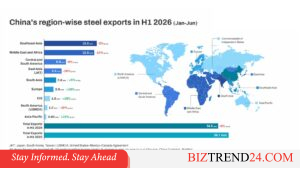
Exports in H1CY’26 dropped by 6% y-o-y to 54.9 mnt, driven by lower volumes to the Middle East, Central and South America, and East Asia. The decline points to mounting trade barriers, higher export costs, geopolitical disruptions, and improving steel supply outside China, all of which are gradually reducing overseas demand for Chinese steel.
Trade actions emerge as biggest drag:
Trade protectionism has become the largest headwind for Chinese steel exports. As per projections by Dao Fortune, anti-dumping measures alone could reduce exports by nearly 14.7 mnt compared with 2025, more than doubling their impact from last year.
Of the 75 new anti-dumping and countervailing duty (AD/CVD) investigations, China accounted for 27 of those cases, more than any other country. Of the 395 AD/CVD measures in force worldwide, 113 targeted Chinese steel products, underscoring the growing protectionist pressure.
Besides anti-dumping duties, Chinese exporters are also facing anti-circumvention investigations, safeguard measures, and tighter import scrutiny across several major markets.
India’s 12% safeguard duty on flat steel, Vietnam’s anti-circumvention duty on Chinese hot-rolled coil, Brazil’s anti-dumping duties, the EU’s tighter safeguard regime, and the US’s Section 232 tariffs have curbed markets for Chinese mills. New investigations launched this year by Japan, the EU, India, Brazil, and South Korea suggest these pressures are likely to intensify rather than ease.
The EU’s latest safeguard revision is particularly significant. China does not receive a dedicated country quota, so the smaller residual quota available to “other countries” means Chinese exporters will face stiffer competition for tariff-free access and a higher likelihood of shipments attracting the 50% duty.
Export economics becoming unfavourable:
Trade barriers are coinciding with rising export costs, further eroding the competitiveness of Chinese steel. To illustrate, Chinese HRC export offers averaged around 7% higher y-o-y in H1CY’26 at $493/tonne (t) FOB Rizhao, driven by higher iron ore and coke costs.
BigMint expects Chinese export prices to remain relatively firm as appreciation (5% y-o-y) of the renminbi against the US dollar and strict VAT evasion checks limit mills’ ability to reduce export offers.
Since the export VAT rebate was withdrawn, exporters have been unable to recover the 13% value-added tax incurred during production, raising effective export costs and squeezing margins, particularly for commodity-grade steel products.
Furthermore, higher freight rates, increasing energy costs, and geopolitical tensions are also likely to foster caution among buyers in key markets such as in the Middle East and Central and South America.
Overseas steel production recovering:
Another structural challenge is the recovery of steel production outside China. World crude steel output remained broadly stable at 931.5 mnt in the first half of 2026, compared with 934.3 mnt a year earlier. However, as China’s production fell 2.9% y-o-y to 500 mnt, output in the rest of the world rose by 2.9% to 431.5 mnt.
The increase reflects capacity additions and stronger production in markets such as India, Southeast Asia, and the Middle East, enabling importing countries to meet a larger share of domestic demand locally and gradually reducing their dependence on Chinese steel exports.
Exports to remain elevated despite challenging trade environment:
Despite mounting trade barriers, China’s steel exports are expected to remain above historical averages. Weak domestic demand, competitive pricing, and the absence of drastic supply-side discipline will continue to make exports an important outlet for Chinese mills.
The prolonged downturn in the property sector has kept domestic steel consumption subdued, while infrastructure spending has been insufficient to offset the decline. At the same time, Chinese steel remains competitively priced, with HRC export offers averaging at around $497.5/t FOB in July, below comparable offers from Japan ($535/t) and India ($535/t, to Southeast Asia and the Middle East), helping mills secure orders in price-sensitive markets.
Low domestic profitability also continues to encourage exports, as selling overseas remains more attractive than competing in a weak domestic market. Meanwhile, with no nationwide production cuts large enough to materially tighten supply, mills are expected to remain export oriented. Continued expansion in global manufacturing is also likely to support both direct steel exports and indirect exports through steel-intensive manufactured goods.
Mills seek alternative export channels:
Semi-finished exports could become increasingly important as trade barriers tighten as these products are outside the purview of duties imposed on finished steel. Slabs, for instance, fall outside the scope of the EU’s steel safeguard measures, allowing overseas re-rollers to import semi-finished steel and process it into finished products within Europe.
China’s semi-finished steel exports surged 63% y-o-y in the first half of 2026 due to the absence of Iran from the global market following the eruption of geopolitical conflict in the Middle East. As a result, combined exports of finished and semi-finished steel edged up 0.7% y-o-y to 64.5 mnt during January-June, suggesting that part of the decline in finished steel exports reflects a change in product mix rather than a reduction in overseas demand.
Indirect steel exports gain momentum:
China’s indirect steel exports are also becoming an increasingly important outlet for China’s steel surplus. Rather than exporting steel itself, Chinese manufacturers are shipping more steel-intensive products overseas.
China’s total merchandise exports increased 13.4% y-o-y to RMB 14.73 trillion ($2.2 trillion) during the first half of 2026. Exports of mechanical and electrical products rose 20.1% to RMB 9.36 trillion ($1.4 trillion), accounting for 63.5% of total exports, while high-tech product exports jumped 39% to RMB 3.26 trillion ($489 billion).
The trend is particularly evident in capital goods. Vehicle exports climbed more than 65% y-o-y to 5.10 million units, supported by a doubling of new energy vehicle exports to 2.36 million units. Chinese shipbuilders also secured 121.06 million deadweight tonnes of new orders, up 173.1% y-o-y and accounting for 82.3% of global new shipbuilding orders.
Household appliance exports also remained resilient. Refrigerator exports increased 14.6% y-o-y during H1CY’26, washing machine exports rose 10.1%, while LCD television exports grew 2.9%. Although air-conditioner exports declined 4.6%, manufactured goods continue to provide an important channel for exporting Chinese steel indirectly.
Outlook:
China’s steel exports appear to be entering a period of normalisation rather than a sharp contraction.
BigMint projects finished steel exports to ease to 110-115 mnt in CY’26 as escalating trade barriers, rising export costs, and expanding overseas steel production reduce the pace of direct exports.
However, although the record-breaking export volume achieved last year is unlikely to be repeated, China’s steel exports are expected to remain well above historical averages, driven by the protracted domestic demand slump.
Going forward, the country’s competitive advantage is likely to rely less on exporting commodity-grade finished steel and increasingly on semi-finished products and steel-intensive manufactured goods, allowing mills to preserve overseas market share despite a more restrictive global trade environment. The export licencing scheme is also favouring higher exports of value-added specialty steel as opposed to commodity-grade steel.