
India’s steel imports stable y-o-y in Jan-Jun’26 despite safeguard duty as flats shipments rise under re-export scheme

-
- Total steel imports drop just 3% y-o-y in H1CY’26 to 4.24 mnt from 4.38 mnt in H1CY’25
-
- Imports of semis, largely slabs, outside duty purview expected to increase in H2CY’26
-
- DGTR’s antidumping probe into HRC may moderate flat steel imports in H2
Morning Brief: India’s total steel imports remained broadly stable at 4.24 million tonnes (mnt) during January-June 2026 (H1CY’26) compared with 4.38 mnt in the corresponding period last year, as per provisional data available with BigMint. This is a marginal decrease of 3% y-o-y. Beneath the stable headline figure, however, import trends diverged across product categories.

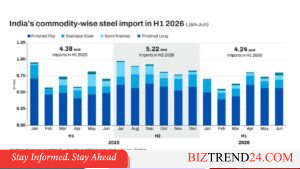
Out of total imports, flat steel shipments increased by 1.2% y-o-y to 3.09 mnt from 3.05 mnt in the year-ago period. Imports of stainless steel (finished + semis) also increased by 4.7% y-o-y to 0.77 mnt. Semis imports declined to 0.24 mnt, a decrease of 43% y-o-y. Semis imports declined primarily because slab volumes sourced by a leading primary steel producer from its overseas subsidiary fell sharply during the period under review.
Finished long steel imports decreased by 18% y-o-y to 0.14 mnt.
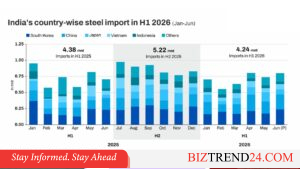
South Korea remained India’s largest steel supplier during H1 CY’26 with imports of 1.16 mnt, followed by China at 1.13 mnt and Japan at 0.59 mnt. Together, the three countries continued to dominate India’s import basket despite safeguard measures.
Why total imports declined:
The government’s 12% safeguard duty on select carbon flat steel products reduced the commercial incentive for routine imports during H1 CY’26.
Import economics also shifted following the safeguard duty. As of 28 July, imported HRC from both non-FTA and FTA countries was estimated to land in India at around INR 62,500-63,500/t, compared with prevailing domestic HRC prices of around INR 57,700/t, as per BigMint data. The safeguard effectively reversed the cost advantage previously enjoyed by imported material, leaving overseas HRC at a premium of around INR 4,800-5,800/t over domestic steel and significantly reducing the commercial viability of imports for domestic consumption.
Buyers increasingly substituted imports with domestic supply as import economics deteriorated. Flat steel imports, however, proved more resilient because a significant share comprised specialised grades or material procured for export-oriented manufacturing rather than routine domestic consumption.
Why flat steel imports remained strong:
The safeguard duty had a limited impact on flat steel imports because a significant share of these volumes was linked to export-oriented manufacturing rather than discretionary domestic purchases. HRC imports increased 7.5% y-o-y to 1.29 mnt during H1 CY’26 despite the overall decline in steel imports.
A key contributor was the Advance Authorisation Scheme, which allows manufacturer-exporters and merchant-exporters to import raw materials duty-free for incorporation into export products, subject to prescribed export obligations. By exempting imports from customs duties and allowing manufacturers to source material not requiring BIS certification, the scheme lowers working capital requirements and supports export-oriented production.
Industry sources said a substantial portion of imported HRC is consumed by pipe and tube manufacturers producing line pipes and API-grade pipes for overseas oil and gas projects rather than sold in the domestic market. One market participant estimated that a single exporter imports around 10,000 t of HRC every month for manufacturing API pipes destined for re-export.
For instance, there is continued interest in importing cold-rolled coils (CRC) under the scheme for manufacturing products such as steel drums for re-exports. Flat steel imports were predominantly from companies in India from their parent companies overseas for supply of approved grades to the domestic automotive players. These were within the purview of duty but could not be limited due to the presence of long-established supply chains. However, the imports were not sourced for the domestic trade market.
Consequently, duty-free imports under the Advance Authorisation Scheme continued to support flat steel import volumes without materially affecting domestic market fundamentals. BigMint data showed domestic HRC prices remained comparatively resilient despite higher imports. The spread between HRC and blast furnace-origin rebar currently exceeds INR 7,000/t. While rebar prices have declined by more than INR 9,000/t over the past three months, domestic HRC prices have eased by only around INR 500/t over the same period, indicating that import volumes under the scheme have not exerted meaningful pressure on domestic flat steel prices.
Stainless steel imports unaffected:
Stainless steel imports increased marginally to around 0.77 mnt during H1 CY’26, supported in part by the government’s decision to exclude stainless steel from the three-year safeguard duty imposed on select flat steel products.
The exemption reflected the specialised nature of stainless steel products, ongoing raw material constraints and downstream grade requirements, which the government cited while keeping the segment outside the safeguard regime. As a result, stainless steel imports continued largely under prevailing market conditions even as safeguard measures curbed imports of carbon steel products.
Outlook:
Reflecting concerns over the continued resilience of flat steel imports, the Directorate General of Trade Remedies (DGTR) has initiated anti-dumping investigations into hot-rolled flat steel imports from China, Japan and Russia, signalling a shift from broad safeguard measures towards product-specific trade remedies.
The investigation is expected to have a direct bearing on imports from both FTA and non-FTA countries during the second half of the year. However, flat steel imports are likely to remain comparatively resilient in the near term, supported by export-oriented procurement under the Advance Authorisation Scheme only.
Another notable development is likely to be an increase in imports of semi-finished steel, particularly slabs, by primary steelmakers. As semi-finished products remain outside the scope of both the safeguard duty and the ongoing anti-dumping investigation, mills are expected to increase slab imports for downstream rolling into finished steel products. Consequently, BigMint expects semi-finished steel imports to increase during H2 CY’26.