

Indian govt imposes definitive anti-dumping duty on met coke imports for 5 years

-
- ADD unlikely to curb India’s met coke imports amid cost and quality advantage
-
- Govt has notified lower definitive duties than provisional duties previously imposed
The government lhas notified a definitive anti-dumping duty (ADD) on imports of low ash metallurgical coke originating in or exported from Australia, China, Colombia, Indonesia, Japan and Russia, following the Directorate General of Trade Remedies’ (DGTR) final determination that dumped imports from these countries had caused material injury to the domestic industry. Issued by the Ministry of Finance on 27 July 2026, the notification covers low ash metallurgical coke containing less than 18% ash.

Country-wise duty structure aims to neutralise unfair pricing:
Under the notification, the government has imposed anti-dumping duties of $42.95/t on Japan, $67.50/t on Indonesia, $71.16/t on Australia, $84.16/t on Russia, $118.55/t on Colombia and $128.83/t on China The duty will also apply to material exported through third countries if originating from any of the six subject nations.
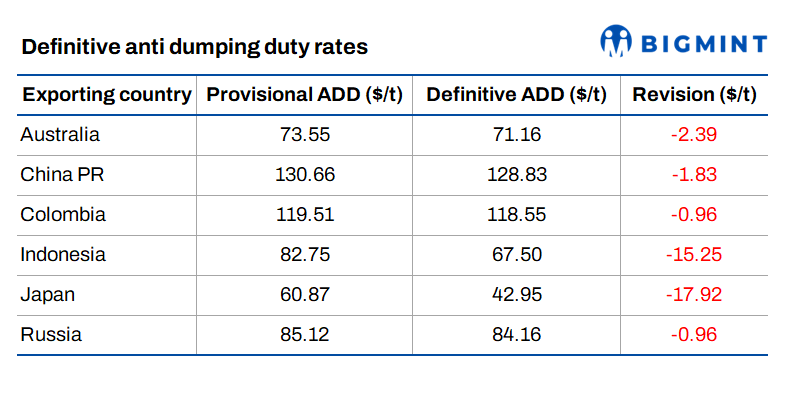
The notification further exempts ultra-low phosphorus metallurgical coke used in ferro alloys manufacturing, semi-coke/soft coke, and specified low ash metallurgical coke imported by actual users for pig iron production in blast furnaces up to 130 cubic metres, subject to prescribed end-use conditions. The definitive duty will remain in force for five years, unless amended or withdrawn earlier.
Import demand remains resilient despite trade protection:
Despite the continuation of anti-dumping duties, India’s metallurgical coke imports increased 44% y-o-y to 2.91 million tonnes (mnt) during January-June 2026, highlighting the limited impact of trade measures on procurement behaviour. Imported material continued to retain a cost advantage, superior coke quality, and operational consistency compared with domestic supplies, making it the preferred feedstock for integrated steelmakers. At the same time, higher hot metal production and robust pig iron exports amid expanding Indonesian export availability further propelled imports.
Indonesia consolidates dominance in India’s import market:
BigMint data indicate that Indonesia remained India’s largest metallurgical coke supplier, with shipments surging 165% y-o-y to 2.09 mnt during H1 CY’26 from 0.79 mnt a year earlier. The sharp increase was driven by Indonesia’s competitive pricing, expanding production capacity and consistent product quality. Poland emerged as the second-largest supplier with 0.48 mnt, followed by Colombia (0.14 mnt), the United States (0.10 mnt) and Japan (0.09 mnt).
Domestic production growth trails import expansion:
India’s domestic metallurgical coke production rose 6% y-o-y to 26.8 mnt during H1 CY’26 from 25.3 mnt in the corresponding period last year. However, the growth remained insufficient to offset the rapid rise in demand, which naturally led to higher imports, particularly as domestic coke producers continued to face challenges related to production costs, quality consistency and capacity utilisation. Consequently, imported coke maintained its competitiveness despite the imposition of anti-dumping duties.
Outlook:
The notification provides long-term policy certainty for domestic met coke producers by formalising trade protection for the next five years. However, the definitive duty is unlikely to materially curb import volumes in the near term, as the current duty levels have largely been factored into procurement decisions since the provisional levy was introduced. Unless domestic producers significantly improve cost competitiveness, product quality and supply reliability, Indian steelmakers are expected to continue sourcing imported met coke, particularly from Indonesia.
Consequently, India’s met coke imports are projected to reach a multi-year high in CY’26, supported by sustained blast furnace steel production, favourable import economics and stable overseas supply, while the definitive ADD is expected to moderate import growth rather than reverse the prevailing trend.