

India’s thermal coal port inventories remain stable amid selective imports

-
- Adani holding the largest inventory at ports
-
- Domestic coal continues dominating procurement
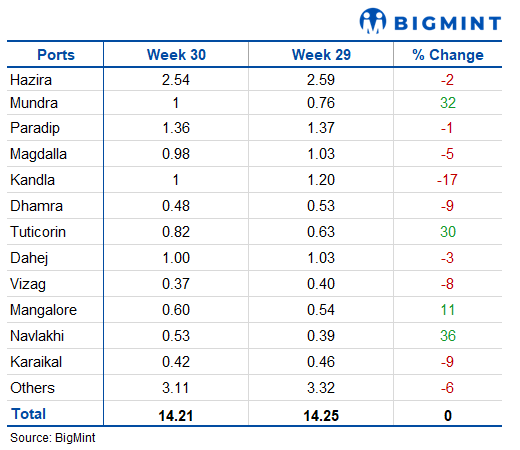
India’s thermal coal inventories at major ports remained largely stable last week, easing marginally to 14.21 million tonnes (mnt) from 14.25 mnt in the previous week. The slight decline was primarily driven by inventory drawdowns at Kandla, Dhamra, Hazira, Vizag and other ports, which were offset by fresh stock replenishment at Mundra, Navlakhi, Tuticorin and Mangalore.

Stable inventory levels indicate that import arrivals remained broadly balanced with cargo evacuations, as consumers continued to procure imported coal selectively amid comfortable domestic coal availability and adequate fuel stocks.
Mundra, Navlakhi and Tuticorin witness fresh inventory build-up:
Among the major ports, Navlakhi recorded the highest weekly increase, with inventories rising 36% w-o-w to 0.53 mnt in week 30 from 0.39 mnt in week 29, reflecting fresh cargo arrivals and stock replenishment. Mundra followed, with inventories increasing 32% to 1 mnt from 0.76 mnt, while Tuticorin registered a 30% rise to 0.82 mnt. Mangalore also recorded an 13.5% increase, with inventories reaching 0.60 mnt, indicating steady import inflows during the week.
Kandla leads inventory drawdown among major ports:
Inventories declined across several major ports, led by Kandla, where stocks fell 17% w-o-w to 1 mnt. Dhamra and Karaikal each recorded a 9% decline, while Vizag slipped 8%. Magdalla, Dahej, Hazira and Paradip also witnessed modest inventory drawdowns, while stocks at other minor ports declined 6% to 3.11 mnt.
Adani remains largest inventory holder:
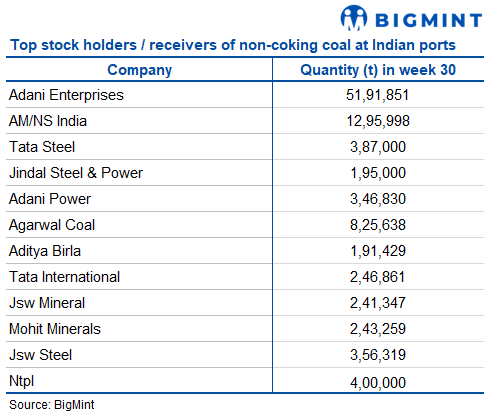
Adani Enterprises remained the largest holder of non-coking coal inventories at Indian ports, maintaining stocks of 5.19 mnt, further consolidating its dominance in the imported coal supply chain. AM/NS India retained the second position with 1.3 mnt, while Agarwal Coal continued to be the largest independent coal trader, holding 0.83 mnt of non-coking coal inventories.
Among other major inventory holders, NTPL held 0.4 mnt, while Tata Steel maintained 0.39 mnt. JSW Steel, Adani Power, Tata International, Mohit Minerals, JSW Mineral and Aditya Birla each held inventories in the range of 0.19-0.36 mnt.
Meanwhile, Jindal Steel & Power remained among the leanest inventory holders with around 0.2 mnt, reflecting continued reliance on requirement-based procurement supported by comfortable domestic coal availability.
Market dynamics:
India’s non-coking coal market remained well supplied last week, supported by regular Coal India dispatches, ample domestic coal availability and comfortable fuel inventories. Although thermal coal inventories at major ports remained broadly stable, the limited movement suggests import arrivals continued to remain largely in line with cargo evacuations as buyers restricted purchases to immediate operational requirements.
Weak demand from the steel and sponge iron sectors, coupled with subdued industrial activity during monsoon, continued to limit imported coal purchases. Cement sector demand remained relatively stable, but consumers largely preferred domestic coal due to its competitive pricing, reliable availability and uninterrupted Coal India supplies.
Internationally, Indonesian thermal coal prices remained largely stable as subdued Indian demand offset support from Indonesia’s proposed single-gate export mechanism and expectations of stronger Chinese buying. South African thermal coal prices remained firm on higher freight costs and replacement values, although the increase failed to stimulate significant import demand because of the wide price gap with domestic coal. Higher bunker prices and firm freight markets also continued to support seaborne coal prices.
The inventory build-up at Mundra, Navlakhi and Tuticorin suggests fresh cargo arrivals and stock replenishment during the week, while drawdowns at Kandla, Dhamra, Hazira and Vizag indicate steady cargo evacuations. Overall, inventory movements reflected balanced trade flows rather than aggressive stock accumulation.
Outlook:
Imported thermal coal demand is expected to remain selective in the near term as consumers continue to rely on comfortable inventories and requirement-based procurement. Domestic coal is likely to remain the preferred fuel due to its cost competitiveness, uninterrupted availability and regular Coal India dispatches. While firm international freight rates and geopolitical developments are expected to support seaborne coal prices, a meaningful recovery in import demand is likely only after post-monsoon improvement in industrial activity and steel consumption.