

China weekly: Steel prices weaken as seasonal demand fails to absorb rising supply

-
- Steel inventories rise 3% as weak demand pressures prices
-
- Rebar and HRC prices fall amid seasonal demand weakness
China’s steel market remained under pressure during the week ended 24 July 2026, as seasonal demand weakness, rising inventories and uneven downstream consumption outweighed support from mill maintenance, lower raw material costs and policy expectations. Total steel inventories at key China Iron and Steel Association (CISA)-affiliated industries rose by around 490,000 tonnes (t), or 3% w-o-w, to 16.77 million tonnes (mnt) during 1-10 July from 16.28 mnt in late June, highlighting the market’s weak absorption capacity.

Heavy rainfall in southern China, high temperatures in the north and typhoon-related disruptions continued to slow outdoor construction. End-users therefore largely adopted just-in-time procurement and maintained low inventories, keeping spot transactions volatile and limiting the ability of the market to absorb available steel supply.
The weakness was particularly evident in construction steel, where subdued real estate activity and delays in infrastructure project execution continued to weigh on demand.
Meanwhile, manufacturing demand remained mixed. Traditional sectors such as construction machinery and general steel structures weakened, while wind power, energy storage, marine engineering, new energy vehicles and high-end equipment provided some support. However, growth in these emerging sectors was insufficient to offset the broader weakness in construction-related steel consumption.
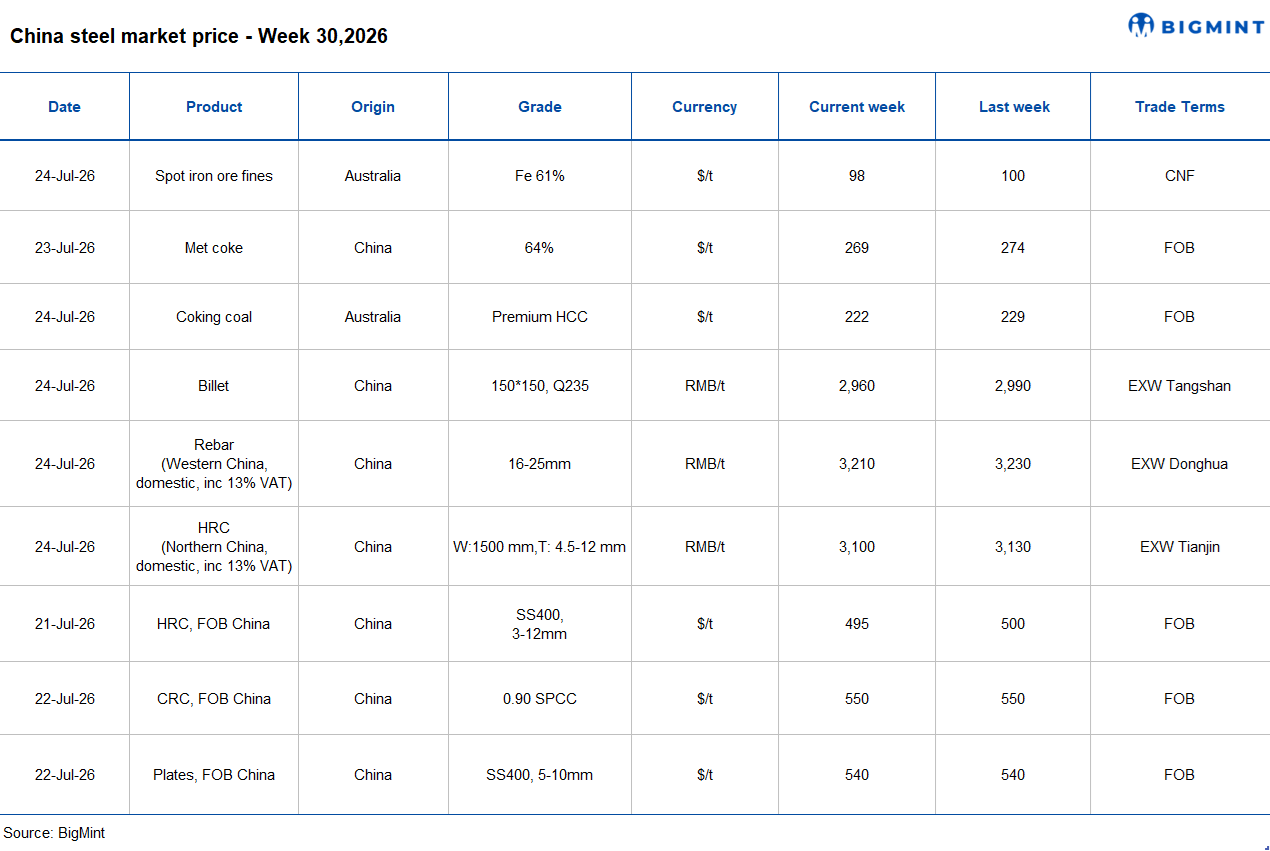
Raw materials front:
Iron ore spot prices decline w-o-w: Iron ore fines benchmark prices for Fe 61% drop w-o-w by $2/t w-o-w to $98/dmt CFR China on 24 Jul’26. Seaborne iron ore prices eased as weak spot buying and abundant medium-grade fines supply outweighed support from higher freight and energy costs.
Market sentiment remained subdued amid concerns that fresh US trade restrictions could dampen overseas demand for Chinese steel and manufactured goods, adding to uncertainty over iron ore consumption.
a) Spot pellet premium steady w-o-w: Spot pellet premium for Fe 65% grade pellet remained firm at $23.6/t CFR China on 22 July.
b) Spot lump premium rangebound w-o-w: Spot lump premium remained largely firm w-o-w at $0.2300/t CFR China on 24 July.
China coke prices decline as weak steel demand offsets lower coking coal costs: China’s coke market remained weak w-o-w, with the first round of CNY 50-55/t ($7-8/t) price cuts fully implemented amid high coke output and subdued steel demand. Steel mill maintenance and weaker margins curtailed procurement, leading to inventory build-up at coke plants. Meanwhile, domestic coking coal prices were largely stable as tight mine supply from safety inspections offset weak buying interest.
In the seaborne coking coal market, Australian premium hard coking coal (PHCC) prices declined by $7/t w-o-w to $222/t FOB, reducing raw material costs for coke producers. Reflecting the softer seaborne market, BigMint’s PHCC index was assessed at $243/t CNF Paradip, India, on 24 July 2026, down $7/t w-o-w. The index is approaching a four-month low, with comparable levels last recorded in early Mar’26, according to BigMint data. Despite lower coking coal costs, domestic coke prices remained largely unchanged as producers balanced easing input costs against subdued demand and cautious inventory management.
Billet prices soften w-o-w amid weak demand: Chinese billet and rebar prices weakened during the week ended 24 July as sluggish seasonal steel demand, easing raw material costs, and cautious market sentiment outweighed support from production cuts and mill maintenance. BigMint assessed domestic billet at RMB 2,960/t ($437/t) on 24 July, down RMB 30/t ($4/t) w-o-w from RMB 2,990/t ($442/t) on 17 July.
In the export market, Chinese billet offers remained stable at around $460/t FOB, while mills maintained base offer levels and focused on project and tender sales. Rising freight costs, port congestion, and continued trade barriers kept export sentiment cautious despite stable overseas enquiries.
Steel price trend:
Rebar prices drop w-o-w: China’s rebar prices declined by RMB 20/t ($3/t) w-o-w to around RMB 3,210/t ($474/t) on 24 July from RMB 3,230/t ($477/t a week earlier.
SHFE rebar futures for the October 2026 contract also declined by RMB 23/t ($3/t) to RMB 3,086/t ($456/t) on 24 July from RMB 3,109/t ($459/t) a week earlier.
Construction-related demand remained the primary weakness in the rebar market. Continued weakness in the real estate sector, slower construction progress and seasonal weather disruptions kept downstream steel consumption muted. Buyers largely procured only against immediate requirements and avoided building significant inventories.
On the supply side, steel mill production remained relatively stable. No large-scale production cuts or concentrated maintenance were expected to materially reduce availability. This left the market facing elevated supply pressure at a time when demand remained weak.
The increase in steel inventories further highlighted the imbalance between supply and demand. As inventories rose and market participants maintained a cautious approach, rebar prices moved lower during the week.
However, prices were already at relatively low levels, which could limit the extent of further downside in the immediate period ahead. The market’s direction will therefore remain closely linked to whether seasonal demand improves sufficiently to absorb available steel.
Meanwhile, China’s Shagang Steel reduced its domestic long steel prices by RMB 100/t ($15/t) for late-July 2026 sales, reflecting cautious market sentiment amid weak seasonal demand and subdued spot activity.
The producer set prices at:
-
- Rebars (16-25 mm): RMB 3,300/t ($487/t)
-
- Coiled rebars (8-10 mm): RMB 3,430/t ($507/t)
-
- Wire rods (6-10 mm): RMB 3,340/t ($493/t)
The price reduction came as downstream consumers continued to procure mainly against immediate requirements. High temperatures and heavy rainfall continued to suppress construction activity during the traditional summer off-season.
Domestic hot-rolled coil (HRC) prices decrease w-o-w: Chinese domestic HRC prices declined by RMB 30/t ($4/t) w-o-w to around RMB 3,100/t ($458/t) on 24 July from RMB 3,130/t ($462/t) a week earlier.
SHFE HRC futures for the October 2026 contract also declined to RMB 3,298/t ($487/t) from RMB 3,314/t ($489/t) a week earlier.
The domestic HRC market remained weak and volatile as the impact of earlier mill maintenance on production gradually faded. As mills resumed operations, supply recovered and inventories began to accumulate again.
At the same time, high temperatures and heavy rainfall continued to limit downstream activity. Buyers remained focused on essential purchases, restricting inventory accumulation and reducing spot market liquidity.
The combination of rising supply and subdued demand kept prices under pressure. However, the downside remained limited as current HRC prices were already close to production costs for many mills. This cost support could restrict the extent of further price declines unless demand weakens materially or supply increases further.
Chinese HRC export offers decreased by $5/t w-o-w to around $495/t FOB Rizhao from $500/t a week earlier.
The decline in export offers reflected cautious sentiment in the international market. While overseas enquiries remained stable, rising freight costs, port congestion and continuing trade barriers limited the competitiveness of Chinese exports. Concerns over fresh US trade restrictions also added uncertainty to the outlook for overseas demand.
Outlook:
China’s steel market is expected to remain weak and volatile next week. Rising crude oil prices may increase freight and energy costs, while policy expectations and stable macroeconomic conditions could offer some support.
However, as mills resume operations, rising supply could lead to further inventory accumulation if demand remains weak. Despite cost support from lower raw material prices, steel prices are nearing levels that limit further downside due to margin pressure.
Demand recovery will remain the key price driver. Unless downstream consumption and construction activity improve, steel prices are likely to remain under pressure.