
India: Met coke imports jump 44% in H1 CY26 despite anti-dumping duty; Indonesia strengthens market dominance

-
- Imports rise to 2.91 mnt in H1 CY26 from 2.02 mnt a year earlier
-
- Higher hot metal output and pig iron exports sustain import demand despite anti-dumping duty
-
- Indonesia accounts for over 70% of imports as Chinese-operated capacity reshapes global trade
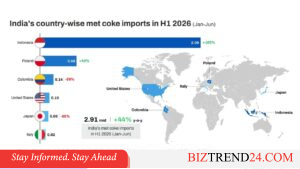
Morning Brief: India’s metallurgical coke imports rose 44% year-on-year (Y-o-Y) to 2.91 million tonnes (mnt) during January-June 2026 despite the imposition of anti-dumping duties, as imported material continued to retain both cost and quality advantages over domestic supply. Higher hot metal production, rising pig iron exports and expanding Indonesian export capacity helped sustain import demand, reinforcing the country’s dependence on overseas met coke for blast furnace steelmaking.

BigMint data show Indonesia remained India’s dominant supplier, with shipments surging 165% (Y-o-Y) to 2.09 mnt from 0.79 mnt in H1 CY25. Poland ranked second with 0.48 mnt, followed by Colombia (0.14 mnt), the United States (0.10 mnt) and Japan (0.09 mnt). On the import side, Visakhapatnam handled the largest volumes at 0.81 mnt, followed by Haldia (0.80 mnt), Hazira (0.54 mnt) and Paradip (0.36 mnt).
Higher hot metal output and pig iron exports lift demand:
India’s rising blast furnace production has also supported stronger import demand. Hot metal production increased to 48.32 mnt during H1 CY26 from 47.13 mnt a year earlier, while domestic met coke production inched up in H1 CY26.
Export demand has further reinforced import requirements. India’s pig iron exports rose to 0.46 mnt during H1 CY26 from 0.14 mnt in the corresponding period last year, with the United States remaining the largest destination. The US continues to rely on imported pig iron because domestic production is limited and largely consumed internally, while electric arc furnace steelmakers use pig iron alongside ferrous scrap to improve metallic quality and steel chemistry. Strong overseas demand has encouraged Indian producers to maximise export sales, increasing their requirement for competitively priced imported met coke.
Indonesia consolidates its position as India’s largest supplier:
Indonesia accounted for nearly three-quarters of India’s met coke imports during the first half of the year, supported by rapid capacity additions at the Indonesia Morowali Industrial Park (IMIP), where Chinese-invested producers have transformed the country into the world’s largest supplier of exportable metallurgical coke. As of May 2026, IMIP’s operating coke capacity had reached 12.7 million tonnes per year, with expected sales of 10.5 mnt during 2026, supplying more than 50 countries and accounting for over 80% of coke trade into India and Southeast Asia.
The competitiveness of Indonesian suppliers extends beyond scale. Chinese operators have developed advanced coal blending techniques using a wider range of coking coal grades, including Russian and Canadian material, supported by integrated logistics, captive infrastructure and improved production technology. These advantages have lowered production costs and strengthened Indonesia’s position relative to conventional merchant coke producers in India.
Import economics remain favourable despite anti-dumping duty:
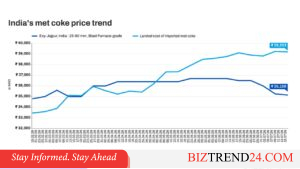
Imported met coke continued to offer a pricing advantage over domestic material despite the anti-dumping duty of US$82.75/t for Indonesian coke. Notably, the Indian government has imposed a provisional anti-dumping duty on imports of low-ash metallurgical coke (with ash content below 18%) for a period of six months and the duty ranged between $60.87/t and $130.6/t, depending on the country of origin. BigMint assessed the landed cost of Indonesian low-ash met coke at around INR 35,000-36,000/t on the east coast, excluding inland freight towards beginning of 2026, compared with domestic blast furnace-grade met coke prices of around INR 36,700/t ex-Jajpur and INR 33,500/t ex-Gandhidham during the assessment period.
Import economics become even more favourable for export-oriented steelmakers operating under the Advance Authorisation Scheme. In India, every tonne of pig iron requires around 450 kg of metallurgical coke, allowing exporters to recover approximately US$21/t of the anti-dumping duty when finished material is exported. As a result, imported coke remains around INR 4,000-5,000/t cheaper than domestic material on an advance licence basis, encouraging mills to continue sourcing overseas material despite the duty.
Apart from pricing, imported coal continues to offer operational advantages. Domestic coal typically contains 29-40% ash, increasing slag generation and blast furnace fuel consumption, whereas imported coal generally contains only 12-14% ash. The lower ash content improves furnace productivity, reduces coke consumption and helps steelmakers maintain consistent hot metal quality, making imported material difficult to substitute despite higher duties.
Outlook:
India’s met coke imports are expected to remain elevated through the second half of CY26 despite anti-dumping duties, as domestic production capacity continues to lag growth in blast furnace steelmaking. BigMint expects hot metal production to remain on an upward trajectory alongside crude steel output, while merchant met coke producers are unlikely to bridge the widening supply gap because of higher production costs, limited integration and quality constraints.
While we expect India’s met coke demand from the steel industry to rise at a 7% CAGR to 52 mnt in FY’30 from 37 mnt in FY’26, domestic production growth has lagged demand expansion in recent years, while quality limitations persist. As a result, we believe a large part of the incremental requirement will be met through imports. However, as met coke imports remain small compared with Indias coking coal imports of around 62 mnt in CY’25, higher met coke shipments are unlikely to significantly affect India’s coking coal procurement.
Indonesia is expected to strengthen its position further as additional coke capacity comes on stream at Chinese-operated industrial complexes, sustaining both cost competitiveness and export availability. Export-oriented Indian steelmakers are also likely to continue importing under the Advance Authorisation Scheme, particularly as pig iron shipments remain firm amid robust demand from the United States and other overseas markets. As long as imported low-ash coke retains both a pricing and quality advantage over domestic supply, imports are expected to account for a growing share of India’s incremental met coke requirement through the remainder of CY26.