

Will sharp drop in EU CRC import quota affect India’s domestic market dynamics and prices? BigMint investigates

-
- EU India’s largest CRC export market with over 95% share in CY’25
-
- Tariff quotas, ongoing CRC AD investigation, CBAM to affect exports
-
- Integrated mills bank on surging domestic demand to counter export loss impact
Data Deep Dive: The European Union’s (EU) recently announced adjustments in tariff-rate quotas (TRQ) for steel imports, effective 1 July 2026, is an extension of steel safeguard quotas, implemented in 2018 as a trade policy to curb surging steel imports, into a full-blown industrial policy to tackle steel overcapacity and boost declining domestic steel production in the EU.

Under its new Steel Regulation, the EU has reduced total tariff-rate quotas by around 47% from the previous safeguard regime while increasing the duty on out-of-quota imports to 50% from 25% for 26 steel products.
India’s CRC export quota cut sharply:
As a leading historical trade partner of the EU, India has retained out-of-quota volumes of flat steel exports at around 1.42 million tonnes (mnt) annually, a sharp decrease of 41% compared with 2.396 mnt earlier. Notably, the hot-rolled coil (HRC) tariff-free quota has been reduced by around 34% while the cold-rolled coil (CRC) quota has dropped even sharply by nearly 60% to 269,974 t from the existing 654,822 t.
The EU continues to account for the largest share of India’s steel exports. India’s finished steel exports of over 3 mnt to the EU in 2025 accounted for 12.3% of the continent’s total imports, as per BigMint data. Flat steel roughly has a share of over 85% of India’s total exports to the EU.
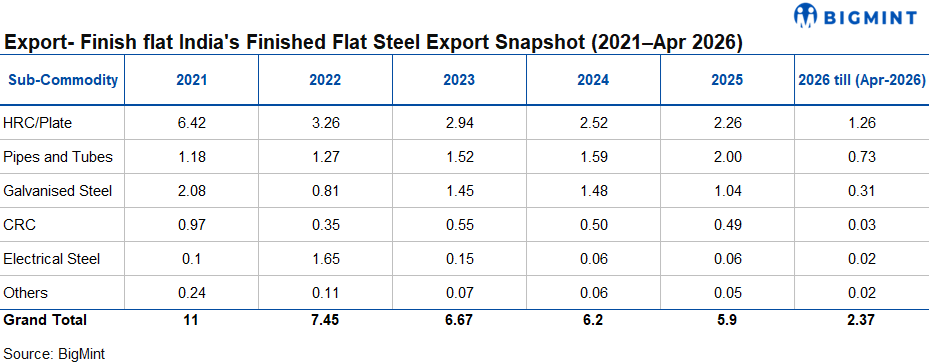
Interestingly, the share of CRC exports to the EU is even higher: in 2025, India’s cumulative CRC exports stood at approximately 493,000 t out of which over 470,000 t were exported to EU countries – a staggeringly high share of nearly 96%. The key importers were Italy, Spain and Belgium. Data show that in 2024 out of total CRC exports of over 500,000 t, more than 440,000 t were exported to the EU – a very high share of over 88% of total exports.
Now, with tariff-free Indian CRC export quota to the EU drastically slashed by 59% annually, what will be the impact on domestic mills and prices? Will the impact be significant or marginal?
Impact on domestic CRC market:
In purely mathematical terms, it would not seem that the impact on the domestic market will be considerable. To illustrate, India’s CRC production, per BigMint data, stood at over 22 mnt in 2025 out of which CRC exports were below 0.5 mnt – a mere 2.2%. Derivatively, the share of exports to the EU was below 2% of total domestic production.
Amid steadily growing domestic demand from the auto, white goods and construction sectors, it seems as if a sharp reduction in exports to the EU will not make a significant dent in the domestic market.
A senior official with a leading Indian steel mill told BigMint: “Following the recent change in EU quota allocations, India’s CRC exports to the bloc are expected to reduce sharply. At present, one of the major integrated mills is exporting nearly 30,000-35,000 t/month of CRC to the EU. A sizeable portion of these volumes is likely to get redirected to the domestic market. However, the industry is not yet witnessing any meaningful surplus in CRC domestically.”
However, the EU’s ongoing antidumping investigation into cold-rolled flat steel imports from India, Japan, Taiwan, Turkiye and Vietnam will weigh on CRC imports into the region over and above the revised import quotas. This is an additional reason why India’s CRC exports to the continent are expected to be affected.
What will be possible impact on CRC prices?
Will domestic CRC prices be affected as a result of curtailed exports to the EU? As a matter of fact, after dropping to five-year lows in December 2025, domestic CRC (0.90mm/CTL, IS 513) prices started firming since January due to the support offered by the government’s imposition of the safeguard duty on steel imports announced on 31 December 2025. CRC prices, in fact, have increased by 13% from January to July – rising from an average of INR 57,822/t ex-yard Mumbai, India, in January to INR 65,100/t in July.
Interestingly, the CRC-HRC spread in the domestic market, which roughly stands in the range of INR 6,000-8,000/t, peaked in April (considering average monthly prices) to INR 7,400/t but slipped to INR 6,800-6,900/t in June. While this is certainly higher than INR 5,833/t in January, it shows that the shrinking spread with HRC still leaves some room for CRC prices to trend up further.
Incidentally, the trend of CRC (0.9 mm, IS 513 Gr.O) export prices to the EU has followed a not dissimilar pattern, peaking after the outbreak of the Iran war since April while again softening a bit in June and July. Notably, CRC CFR Europe prices surged after the war on higher freight and fuel cost support rather than any fundamental shift in demand. The average June price of $770/t CFR was 8% higher y-o-y but marginally down m-o-m.
Earlier in 2025, prices trended up largely in the second half of the year on increased export volumes to the EU before the imposition of the Carbon Border Adjustment Mechanism (CBAM) from 1 January. Data show that monthly CRC exports ticked up September to November largely on higher exports to European countries. In 2026, however, besides the key EU importing countries, shipments to the UK increased following the much-awaited India-UK FTA.
In FOB terms, the current price from key Indian port is assessed at $705/t FOB, which is actually a decline of 1.4% w-o-w but about $20 higher than average prices assessed in April, as per BigMint data. India’s current CRC FOB export prices are around 4% lower than May – the peak so far in 2026. This is due to the general softening in prices following temporary suspension of geopolitical hostilities in the Middle East.
“Benchmark CRC prices in India have in fact firmed. This resilience is underpinned by healthy downstream demand: automobile production is up, while consumer durable and other fabrication segments continue to register strong offtake. Coupled with mill-level supply discipline and higher diversion of HRC into CRC and coated products, this suggests that domestic CRC prices are unlikely to correct sharply despite lower export opportunities to the EU, and are more likely to stay range-bound to slightly firm in the near term,” said the senior official from a leading mill.
The narrative of strong domestic demand is testified by the surge in automobile sales figures. Thanks to GST rate rationalisation, rising per capita income, increasing urbanisation and mobility needs, and increased SUV and EV adoption rates, auto sales have increased significantly since October 2025, and especially in 2026, with SIAM monthly passenger vehicle sales figures being consistently higher y-o-y. For instance, in May PV sales rose to 438,854 units, which was over 26% higher y-o-y compared with 347,421 units in May 2025.
Outlook:
As India’s leading CRC export destination, and as a high-realisation market, the sharp curtailment in tariff-free CRC quotas will affect the leading Indian exporters, as will CBAM costs which are in the $70-75/tCO2 range. However, the extent of the impact on the domestic CRC market will be determined by its ability to absorb volumes meant for exports. In fact, Steel Ministry data show that domestic steel consumption, over 7% higher y-o-y in the April-June quarter, was markedly higher than the below-4% y-o-y growth in crude steel production. Therefore, the fundamentals remain sound.
Boosting domestic production in the EU seems to be a key motto of the new steel import regulations, with EUROFER estimating that around 15 mnt of domestic production will come online. This, of course, remains to be seen. EU crude steel production dropped from around 160 mnt in 2016-2017 to less than 126 mnt in 2025. Narrowing imports may just squeeze the downstream industries and push steel prices higher which might again create demand for imports.
That said, the leading Indian mills and exporters will be squarely focussing on the domestic market with export opportunities to the EU shrinking considerably. Major integrated mill sources believe the impact on domestic CRC prices will not be marked, with prices likely to remain firm-to-rangebound.


