

India’s thermal coal port inventories fall 6% as imports weaken

-
- Port inventories decline as domestic coal curbs imports
-
- Need-based buying continues amid comfortable coal availability
India’s thermal coal inventories at major ports declined by 6.1% week-on-week (w-o-w) to 14.15 million tonnes (mnt) in week 28, compared with 15.07 mnt in the previous week. The decline was primarily driven by lower import arrivals and steady cargo offtake, as consumers continued to rely on comfortable domestic coal supplies while limiting fresh imports to immediate operational requirements.

Ample domestic coal availability, supported by regular Coal India dispatches and the ongoing monsoon, continued to reduce dependence on imported cargoes, resulting in lower stock accumulation at ports.
Top ports retain dominant inventory position:
Hazira retained its position as India’s largest thermal coal stockholding port, with inventories remaining unchanged at 2.55 mnt. Paradip emerged as the largest gainer during the week, with inventories increasing 3% w-o-w to 1.38 mnt, supported by fresh cargo arrivals. Kandla followed, recording a 9.3% increase to 1.29 mnt, indicating replenishment outpaced cargo dispatches.
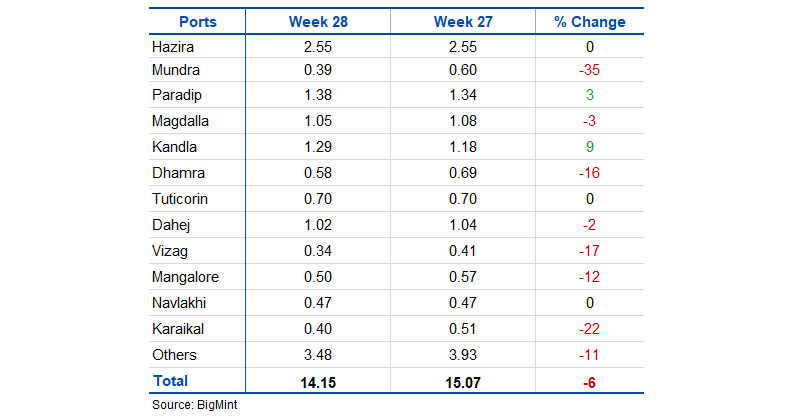
In contrast, Mundra recorded the sharpest decline, with inventories falling 35% w-o-w to 0.39 mnt, reflecting stronger cargo evacuations and lower replenishment during the week. Karaikal followed with a 21.6% decline to 0.40 mnt, while Vizag inventories dropped 17.1% to 0.34 mnt, indicating continued cargo dispatches and subdued import arrivals at both ports.
Adani Enterprises remains the largest inventory holder:
Adani Enterprises continued to hold the largest thermal coal inventory at Indian ports during week 28, with stocks of 5.07 mnt, reflecting its dominant import and distribution network. AM/NS India ranked second with 1.26 mnt, while Agarwal Coal remained the largest trading house after Adani, holding 0.78 mnt of inventories.
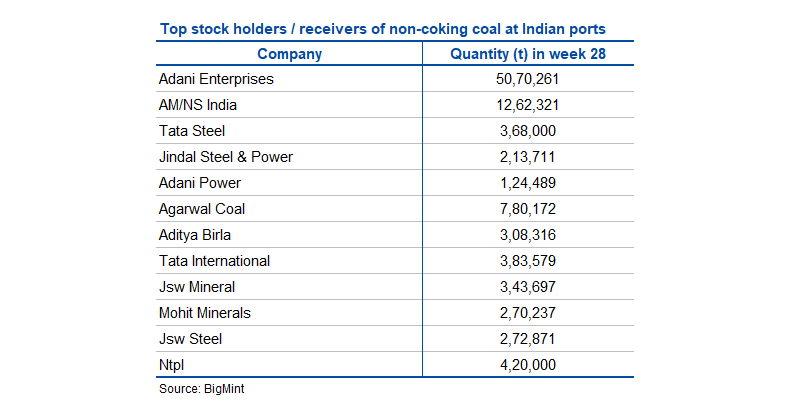
Among the major inventory holders, Adani Power reported the lowest thermal coal inventory at 124,489 t during week 28, followed by Jindal Steel & Power with 213,711 t and Mohit Minerals with 270,237 t. The comparatively lower inventories indicate lean stockholding by these consumers and traders, reflecting continued reliance on requirement-based procurement amid comfortable domestic coal availability and subdued import demand.
Market dynamics:
India’s non-coking coal market remained subdued during the week as comfortable domestic coal availability, regular Coal India subsidiary auctions and the ongoing monsoon continued to weigh on imported thermal coal demand. Buyers largely restricted procurement to immediate requirements, supported by adequate domestic supplies and sufficient inventories, resulting in lower import arrivals and a decline in portside coal stocks.
Weak demand from the steel and sponge iron sectors remained the key factor limiting imported coal purchases. Softer steel prices and sluggish downstream activity continued to discourage aggressive procurement, leading to further corrections in Indonesian and South African thermal coal prices at Indian ports. In contrast, domestic coal retained its competitive edge owing to stable prices, ample availability and uninterrupted Coal India dispatches.
The cement sector also maintained a disciplined buying approach during the monsoon. While lower international petcoke prices improved its competitiveness, consumers continued to optimise fuel blends between domestic coal, imported coal and petcoke rather than rebuild inventories. Overall, domestic coal remained the preferred fuel due to its cost advantage and reliable supply, and imported thermal coal demand is expected to remain selective until industrial activity strengthens after the monsoon.


