

India’s iron ore production surges by 17% y-o-y in H1CY’26 as merchant miners accelerate expansion

-
-
Capacity expansions in Chhattisgarh drive up NMDC’s output by 24%
-
-
-
Lloyds lifts output exponentially post expansion of Surjagarh mines
-
-
-
Growth in steel, pellet production supports ore demand
-
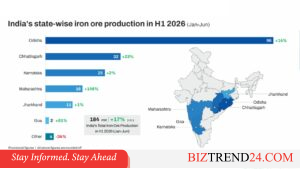
Morning Brief: India’s iron ore production climbed up sharply by 17% y-o-y in H1CY’26 to 184 million tonnes (mnt), according to provisional data maintained by BigMint.

The surge was driven by operational ramp-ups at two of India’s largest merchant miners — National Mineral Development Corporation (NMDC) and Odisha Mining Corporation (OMC). Rapid mine development and capacity operationalisation also drove an exponential 176% increase in output from Maharashtra-based Lloyds Metals and Energy Limited (LMEL).
Consequently, merchant production rose 25% y-o-y in H1CY’26 to 115 mnt, sharper than the 5% growth in captive production to 69 mnt.
Notably, iron ore production outpaced the 7% y-o-y growth in crude steel output in H1CY’26. This marks a sharp reversal from H1CY’25, when iron ore production rose just 3%, trailing the 9% increase in crude steel production.
Merchant miners drive increase in India’s production in H1CY’26:
NMDC’s production up 24% y-o-y on capacity expansions: NMDC’s production surged 24% y-o-y to 31.4 mnt, keeping the miner Indias largest. The company enhanced production capacity in Chhattisgarh substantially: Deposit 14 was increased to 18.5 mnt/year from 10.5 mnt/year and Deposit 5 to 12 mnt/year from 10 mnt/year. This ultimately resulted in higher production from Chhattisgarh.
NMDC has set a production guidance of 60 mnt for FY’27 compared to output of 53 mnt in FY’26. The miner has outlined a detailed roadmap for this, including commencing mining operations from Deposits 4 and 13 in Bailadila.
OMC’s production rebounds amid operational efficiency: Reflecting a sharp recovery from the slower production momentum in CY’25, iron ore output from OMC increased by 28% y-o-y in H1CY’26, driven by operational ramp-ups. Production increased 65% y-o-y from its Gandhamardan mines (attributed to a change in the mine developer and operator model) and by 28% from its Daitari mine.
Lloyds records sharpest growth amid rapid capacity expansions: Lloyds recorded the sharpest y-o-y increase among all miners, as it ramped up capacity at its Surjagarh mines in Maharashtra. Lloyds approved environmental clearance (EC) volume surged to 26 mnt in FY26 from 10 mnt in FY’25.
In Q1CY’26, the company produced 9.1 mnt, up a massive 529%, attributed to operational ramp-ups and improved evacuation efficiency due to the companys slurry pipeline. Although production moderated to 6.05 mnt in Q2CY’26 due to seasonal factors and monsoon-related hurdles, output was still 53% higher y-o-y.
Notably, the company plans to produce 26 mnt in FY’27, 18% higher than its FY’26 output of nearly 22 mnt.
Rising steel production supports ore demand:
India’s crude steel production increased by 7% y-o-y to 87 mnt in H1CY’26, effectively lifting demand for iron ore. Pellet production rose 14% y-o-y to 63 mnt, while sponge iron production climbed up moderately by 6% in H1CY’26, also contributing to iron ore demand.
Higher prices lift mining realisations:
Domestic iron ore prices in H1CY’26 were also over 10% higher y-o-y, improving mining realisations. BigMint’s Odisha iron ore fines (Fe 62%) index averaged INR 5,600/t ex-mines in H1CY’26 compared to nearly INR 5,100/t in the year-ago period.
Export momentum strengthens:
Stronger export momentum also incentivised production. India’s iron ore exports increased by 24% y-o-y in H1CY’26 amid healthy realisations, a weaker rupee, and sustained Chinese demand. Export realisations were at around INR 3,500/t in H1CY’26, rising INR 100/t from last year, allowing miners to maintain healthy overseas dispatches.
Captive producers record slower growth:
Cumulatively, integrated steelmakers continued to increase captive mining at a much slower pace. Production trends were also mixed, with Tata Steel (7%), SAIL (9%), and AM/NS (5%) recording moderate growth. Conversely, JSW Steel and Jindal Steels output fell.
JSW Steel continues to record decline: In CY’25, JSW Steel’s production was consistently lower y-o-y, due to the surrender of the Jajang mines. In H1CY’26, iron ore production continued to decline, primarily from Odisha.
Among its three operating mines, production from Odisha-based Narayanposhi and Nuagaon (both auctioned mines) decreased by 41% and 21%, respectively. However, the company commenced production from its new Netrabandha mine in Odisha from April.
Notably, JSW Steel’s approved mining capacity declined sharply to 29 mnt in FY’26 from 45 mnt in FY’25, primarily due to the surrender of the Jajang iron ore mine in Odisha, one of the company’s key captive assets.
Jindal Steel’s production dips by 3%: Jindal Steel’s production dropped marginally by 3% y-o-y, mainly due to lower output from its TRB mine.
Outlook:
BigMint expects India’s iron ore production to maintain healthy growth of 15% through the remainder of CY’26 to around 335-340 mnt.
Merchant miners will remain the principal source of additional supply. Both NMDC and OMC are likely to sustain double-digit production growth as capacity expansions and operational improvements continue. Lloyds will also ramp up output, though the percentage growth may moderate slightly due to a higher base in the second half of the year.
Additionally, rising steel demand and mill capacity utilisation will encourage integrated steelmakers to increase output, though unfavourable mining economics may keep growth on the slower side. JSW Steel’s operationalisation of Netrabandha mine will also likely boost its output in the coming months.
Notably, despite higher domestic output, iron ore imports rose 33% y-o-y to 4.95 mnt amid shortages of high-grade ore, logistical bottlenecks, and competitive pricing. This indicates that supply issues persist despite higher output.
BigMint understands that the comparative underperformance of the captive miners compared with the PSU merchant miners is due to rising costs of iron ore mining, especially from the auctioned leases.
From inordinate delays in operationalisation of leases to mine surrenders and declining dispatches of ore, particularly high-grade ore to artificially suppress the ASP, higher costs have impacted mining, with many sources in the industry attributing it to double calculation of royalty.
However, the recent SC verdict of including royalty, DMF and NMET in ASP has restored the status quo and no immediate relief from rising cost pressure is in sight.


