

Why China’s coking coal market may remain tight in H2CY’26 despite possible hot metal output cuts

-
- Chance of coking coal production recovery post Shanxi mine accident dim
-
- Australian imports may touch 2 mnt in Jul26 on higher futures prices in June
Limited production recovery:

Horizon Insights: First driver of coking coal price decline in China: Following Qinyuan’s resumption, the market has begun pricing in a full production recovery. On the valuation front, in the second week after the accident, when the market heard a faster-than-expected resumption in Lliang, futures dropped to a low RMB 1,234/t ($181.38/t).
At that point, the market had expected Lliang to begin resuming operations within three-five days of the accident and assumed all regions outside Qinyuan would resume at the same pace, which rapidly drove prices back toward pre-accident steel mill tender levels. Futures have recently returned to roughly that same level, yet the actual production today is far lower than it was at that time.
From this perspective, a further leg down would require the market to price in an even stronger resumption expectation, or even full resumption.
In terms of the pace of Qinyuan’s resumption, apart from one mine that has resumed, the resumption process at all other mines has been put on hold. Last week, output hit a new post-accident low, with on-balance-sheet supply down approximately 18% relative to pre-accident levels. Feedback from field surveys indicates that even at mines that have already resumed, production is running at 20-70% below normal levels.
It is therefore quite possible that even as more mines resume, the production recovery will remain limited, and the expectation that the impact of the mining accident has largely dissipated is at risk of being disproved.
Second driver of price decline:
Mongolian coal continues to exert the greatest valuation pressure on futures. Custom inventories of Mongolian coal have yet to show a meaningful drawdown, and the associated warehouse delivery remains a sword of Damocles hanging over near-month contracts. On prices, custom offers are primarily driven by futures, while downstream acceptance prices lagged materially after the accident, weighing on the physical market. This created a situation where, when futures rallied, the pass-through of spot prices to downstream buyers was impeded, further reinforcing potential warehouse delivery expectations.
The spread observed during last year’s anti-involution period serves as a useful reference. During this rally, the spread between raw coal and washed coal at the custom briefly reached an extreme level of around RMB 200/t. At that spread level, there is high pressure for custom raw coal purchases, which is likely to translate into delivery pressure on futures.
Acceptance of Mongolian coal improving:
After futures prices dragged custom-delivered raw coking coal lower, the spread between downstream offtake prices and raw coking coal prices widened and reached a relatively elevated level for the year, raising the cost-effectiveness of raw coking coal. The key question, therefore, is whether washed coking coal prices can hold at current levels.
Looking at another spread, the price differential between Shanxi coal and Mongolian coal has remained persistently wide. If tightness in Shanxi coal persists, downstream buyers will, given cost-effectiveness considerations, likely show increasing acceptance of Mongolian coal, particularly as downstream margins come under greater pressure while hot metal output needs to be maintained. Mongolian washed coking coal prices may therefore remain supported, though the transition by steel mills toward Mongolian coal will take time.
Moreover, despite the high absolute level of Mongolia’s customs inventories, premium-grade Mongolian Grade 5 material is actually scarce. Should the Shanxi supply deficit persist, Mongolian coal prices could even see a catch-up rally. Mongolian coal supply is expected to decline in July, and long-term agreement prices are expected to rise. In the near term, the Naadam Festival will cap July Mongolian coal import volumes; over a longer horizon, the import pace in the second half is likely to fall short of the first half.
In addition, Mongolia has recently conducted safety inspections of its own, which could constrain the release of its domestic supply flexibility. As Mongolia’s own inventories are gradually drawn down, it cannot sustain an oversold state indefinitely, and the border-crossing pressure on Mongolian coal will in all likelihood ease in the second half. Furthermore, Q3 long-term agreement prices for Mongolian coal are also expected to rise, which will lift the floor support for futures prices.
Key market concern:
Imbalances in steel are becoming increasingly pronounced. Both rebar and HRC have entered an inventory accumulation cycle. While rebar’s absolute inventory level remains low, its accumulation rate has risen noticeably above seasonal norms, and HRC is in a state of elevated accumulation pace and elevated absolute inventory. If demand shows no sign of improvement, steel faces mounting pressure to cut output.
Persistent demand disappointment is the most fundamental driver behind steel’s inventory build; exports are the first area to examine. The softening of exports was already evident in May order intake. The ongoing domestic price decline is further reinforcing a wait-and-see attitude among overseas buyers. In addition, global HRC prices are currently in a broadly declining trend. Based on current order intake as a forward indicator for exports, the inventory overhang cannot be resolved in the near term.
Looking at both profit margins and per-tonne realised profitability at the mill level, hot metal output is expected to hold at elevated levels in the near term, with daily hot metal output in July still projected at around 2.4 mnt/day. However, should demand show no improvement, inventory pressure will likely build to a point where steel mills cut output.
Coking coal supply loss:
From a medium-term perspective, even if mines’ output recovers subsequently, it is unlikely to return to previous peak levels; overproduction will be significantly reduced, and production intensity is expected to remain broadly in line with Q3Q4 of last year.
In terms of current supply losses, compared with pre-accident peak output, daily washed coking coal production based on Mysteel’s sample is currently running approximately 150,000 t below its peak, implying a monthly supply shortfall of around 4 mnt. Looking at average output levels, daily production ran at approximately 800,000 t in H1; assuming H2 output is similar to H2 last year at roughly 750,000 t, the monthly supply loss would be approximately 1.5 mnt.
Off-balance-sheet losses are difficult to estimate in the near term; conservatively assuming a 20% overproduction ratio for private mines, the corresponding monthly loss from this segment is also in the order of 500,000 t-1 mnt. Overall, domestic coking coal supply losses in Q3 could therefore be in the range of 2-3 mnt.
Coal import scenario:
How will the supply gap be bridged? Seaborne imports were subdued before the mine accident, but are expected to provide supplementary supply. The persistent tightness in domestic coking coal supply so far this year has been driven by the decline in seaborne coal imports, particularly the absence of US coking coal imports in the first four months compared with the same period last year, which caused a marked drop in overall seaborne coal import volumes.
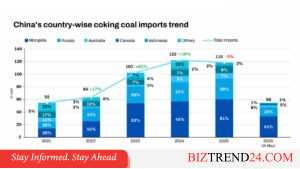
Although imports from Mongolia increased noticeably, the primary product imported is raw coal. By contrast, imports from the US, Canada, and Australia consist mainly of premium hard coking coal (washed), which has a greater impact on the supply balance.
Although Russian coal imports remain profitable, incremental volumes are likely to be limited by Russia’s own production constraints. According to the monthly industrial production report released by Rosstat () on 27 May, cumulative Russian coal output for JanuaryApril 2026 totaled 140 mnt, down 5% y-o-y. Therefore, even with a favourable price spread, meaningful incremental volumes from Russia appear unlikely.
Canada exports virtually all of its coking coal, with annual production of approximately 40 mnt, leaving little room for meaningful export growth. China’s imports from Canada are predominantly under long-term agreements, with market-based trading accounting for a relatively small share. The volume of imports sensitive to price movements is limited, generally fluctuating within a range of 500,000 t-1 mnt.
Bridging supply gap hinges on Australia:
With no meaningful incremental import volumes expected from Mongolia, bridging the domestic coking coal supply gap still depends on Australian seaborne coal. The primary constraint on incremental Australian coal imports is price; Australian and Canadian prices are broadly in line, but Australia offers greater import volume elasticity. Incremental imports are primarily driven by Australia.
The import window opened briefly in May and June following the futures market rally in early May, and import volumes for those two months are expected to increase m-o-m. Historically, Australian coal imports peak toward year-end, approaching 2 mnt. However, benchmarking against H2 last year, once the import price spread turned positive, import volumes generally stands at around 1 mnt.
According to Kpler data, Australian coal imports in July are expected to reach approximately 2 mnt, with shipments driven primarily by the hedging opportunities the futures market offered in early June. However, as futures prices subsequently weakened rapidly, import risks have risen considerably. Although spot import margins remain intact, the decline in futures prices may dampen trader speculation, and the import flow therefore appears more likely to be a one-off pulse. If the futures market fails to offer fresh opportunities, the long-term sustainability of imports remains in doubt.
Under the supply and import assumptions outlined above, coking coal will remain in an inventory drawdown window in Q3 even if hot metal output is cut due to negative feedback. The loss-making conditions at steel mills and coke plants may paradoxically increase consumption of lower-priced Mongolian coal, further accelerating the convergence of the price spread between Mongolian and Shanxi coal.
The article is published as part of a content sharing agreement between Horizon Insights and BigMint.


