

India: Monsoon eases power demand, but coal stock stress persists at several thermal plants

-
- Most stressed utilities in Andhra Pradesh, Telangana, TN, Rajasthan
-
- Coal generation drives supply growth, hydro output declines
The arrival of the southwest monsoon has brought timely relief to India’s power system after a record-breaking May, easing cooling demand across large parts of the country and helping the grid navigate what could have been a more severe summer stress period. However, while all-India demand has moderated from recent peaks, coal stock shortages continue to persist at several thermal power stations, highlighting ongoing vulnerabilities in fuel supply chains and regional coal logistics.

Peak demand moderates from May highs:
India’s peak power demand touched an all-time high of around 271 GW on 21 May amid widespread heatwaves. Since then, the onset of monsoon conditions and pre-monsoon rainfall across southern and western regions has reduced cooling demand.
According to Grid-India data, peak demand met during 1-7 June ranged between 236 GW and 249 GW, significantly below the May record but still well above year-ago levels.
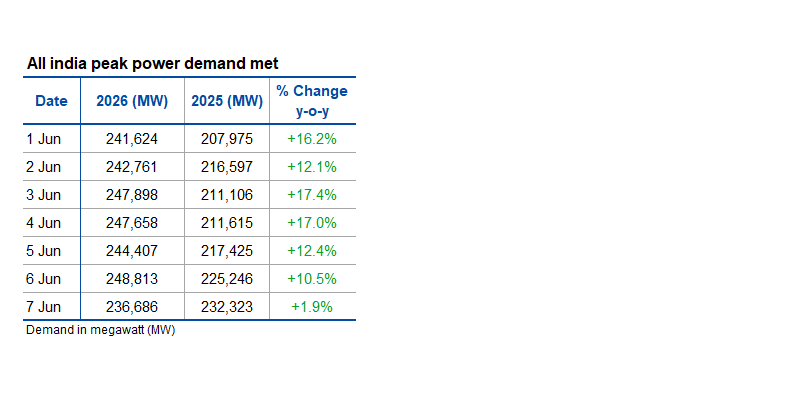
The figures indicate that while weather-driven demand has softened from May’s extreme levels, India’s underlying electricity consumption continues to trend substantially above last year, reflecting structural growth in industrial activity, commercial consumption and residential cooling demand.
Coal stocks remain uneven despite adequate national inventories:
Coal availability at the national level remains significantly better than during previous power crises. However, stock distribution across thermal power stations continues to be uneven.
CEA data showed total coal stock at domestic coal-based power plants stood at approximately 49 million tonnes at the end of May, equivalent to around 16 days of consumption. While this level is broadly adequate from a system perspective, several state-owned utilities continue to operate with stock levels well below normative requirements.
As of 7 June, some of the most stressed utilities included Andhra Pradesh, Telangana, Tamil Nadu and parts of Rajasthan.
Andhra Pradesh faces acute pressure:
Among major utilities, Andhra Pradesh continues to exhibit some of the lowest stock coverage in the country.
APGENCO’s Dr N. Tata Rao TPS held only 22% of normative stock levels, while Rayalaseema TPS was operating with just 15% of normative inventory. The CEA continued to direct Mahanadi Coalfields Ltd (MCL) to ensure coal supplies under the subgroup allocation plan while advising generators to liquidate coal lying at ports.
Damodaram Sanjeevaiah TPS similarly remained under pressure with stocks equal to only 20% of normative requirements.
Telangana stations remain vulnerable:
Several Telangana stations also continued to report low inventory levels.
Bhadradri TPP held stocks equivalent to only 18% of normative requirements, while Yadadri TPS was at 19%. Kothagudem New TPS remained under pressure with inventories covering only around 16% of normative levels.
CEA remarks for multiple Telangana facilities highlighted the need for Singareni Collieries Company Ltd (SCCL) to maintain coal supplies in accordance with agreed dispatch plans.
Tamil Nadu coal inventory remains tight:
Tamil Nadu’s North Chennai complex continues to face inventory challenges despite the presence of imported coal.
North Chennai Stage-2 was operating with only 15% of normative stock, while Stage-3 held approximately 180,000 tonnes of coal, including around 148,000 tonnes of imported material, equivalent to only 16% of normative requirements.
The CEA has repeatedly advised the utility to liquidate coal available at ports and in transit while ensuring additional supplies from SCCL and MCL.
Rajasthan and Madhya Pradesh show mixed trends:
Several Rajasthan stations remain below comfortable inventory levels. Chhabra-II was operating at 49% of normative stock, Kota TPS at 60%, and Suratgarh TPS at 45%.
Meanwhile, Madhya Pradesh’s Shree Singaji TPP held only 28% of normative inventory despite operating at nearly 80% plant load factor, making it one of the more closely watched stations.
In contrast, a number of pithead plants in coal-producing states continue to maintain comfortable inventories, highlighting that logistics rather than coal availability remains the principal challenge.
Coal generation drives supply growth:
Coal-fired generation remained the dominant contributor to India’s electricity supply during the first week of June.
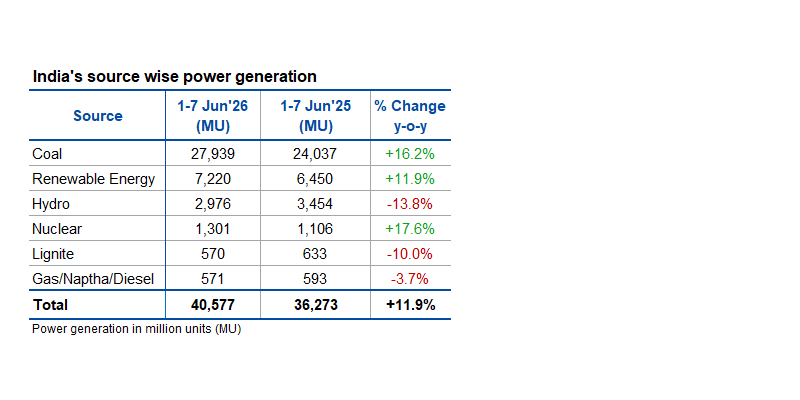
Coal contributed nearly 69% of total generation during the period, broadly unchanged from last year. The increase in coal generation reflects both higher overall demand and continued policy support for maximising thermal generation during the summer period.
Hydro generation declines despite monsoon onset:
One notable feature of the current generation mix is the decline in hydro output.
Hydro generation during 1-7 June fell nearly 14% y-o-y despite the onset of the monsoon. Reservoir levels remain below last year’s levels in several regions following a relatively weak pre-monsoon period.
The lower hydro contribution has increased reliance on coal-fired generation to meet evening demand peaks, particularly after solar generation declines.
Renewables continue growth trajectory:
Renewable generation increased nearly 12% y-o-y during the first week of June, reaching 7,220 MU.
Solar generation continued to provide significant daytime support to the grid, helping suppress demand for conventional generation during daylight hours. However, the system continues to face challenges in managing the transition from daytime solar output to evening peak demand.
This structural issue remains evident in power market pricing.
IEX prices highlight evening tightness:
Although all-India peak shortages have largely disappeared from national statistics, market signals suggest evening supply conditions remain tight.
Day-ahead market prices on the Indian Energy Exchange rose sharply above INR 4,000-5,700/MWh during the first half of the week before easing toward INR 3,000/MWh by 7 June as weather conditions improved.
More importantly, several evening time blocks cleared at or near the exchange price cap, indicating persistent stress during post-solar hours.
The recurring evening tightness underscores a growing challenge for the Indian power system: balancing rising renewable penetration with adequate flexible generation, storage and demand-response resources.
Monsoon progress offers near-term relief:
The southwest monsoon reached Kerala on 4 June and subsequently advanced into Karnataka, Telangana, Andhra Pradesh and Maharashtra.
The progress has helped moderate temperatures across large parts of southern and western India, reducing cooling demand and easing immediate pressure on the power system.
Weather agencies expect further monsoon advancement across central India during the coming weeks, which should continue to restrain demand growth through much of June.