
BigMint’s India steel index rises w-o-w as Iran war drives energy, input costs higher

-
- BF-origin rebar prices at 3-year high in Mar’26
-
- Trade-level flat steel prices soar on rising energy, input costs
-
- Mills may again raise rebar prices on fast inventory drawdown
Morning Brief: Even after rising sharply the week before last due to rising geopolitical disruptions and escalating costs, BigMint’s India steel composite index, a barometer of the domestic market, continued its upward trajectory, although the momentum slackened a bit compared with the week before.

As against a w-o-w surge of 2.3% the week before last, the composite index recorded a comparatively modest increase of 1.3% last week, as assessed on 13 March 2026, with all the key sub-indices remaining in the green. While the longs index showed a modest increase of 0.9% on-week, the flats composite index recorded a 1.7% increase w-o-w.
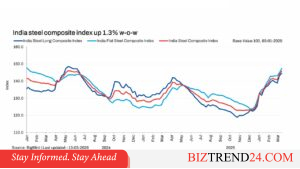
Steel prices soared amid rising costs of inputs and energy as the Iran war in West Asia, a key global energy hub, disrupted shipping and supplies.
Highlights of price movements
HRC, CRC trade prices soar: Trade-level prices of hot-rolled coils (HRC) in India either remained firm or increased across regions, reaching a 28-month high last week. BigMint’s benchmark assessment for HRC (IS2062, Gr E250, 2.5-8 mm/CTL) surged INR 1,000/t ($11/t) w-o-w to INR 55,500/t ($603/t) on 10 March against INR 54,500/t ($592/t) last week.
CRC (IS513, Gr O, 0.9 mm/CTL) prices stood at INR 61,500/t ($668/t), climbing up by INR 1,000/t ($11/t) w-o-w against INR 60,500/t ($657/t) on 10 March.
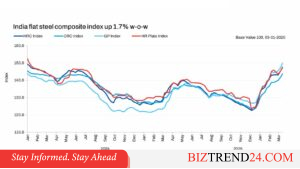
Trade-level HRC prices witnessed an increase due to rising geopolitical tensions between Iran and Israel, which created significant uncertainty across global commodity markets. Increasing freight costs and energy prices intensified panic buying across market segments.
Traders and distributors are attempting to secure inventory ahead of potential supply chain disruptions, pushing HRC prices higher. At the distributor level, material availability remains tight which supported the upward momentum.
Rebar prices surge on inventory reduction: Indian primary steelmakers increased rebar prices by INR 500/tonne (t) ($5/t) last week. Post-revision, list prices stood at INR 58,500-60,000/t ($633-649/t) on landed basis. Trade-level BF-rebar prices have hit a three-year high in March, as per BigMint data.
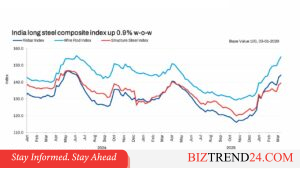
Continuous price hike by the primary mills have led to the surge in prices over the last three months. The surge may be attributed to strong demand from projects, material shortage due to inventory reduction by mills, and the rise in raw material prices over the past few months.
On the other hand, IF-route rebar prices surged by INR 1,800-3,300/t across key regions over the past 10 days. The uptrend was driven by escalating geopolitical tensions, which have raised cost pressures across the steel value chain due to higher energy, freight, and raw material prices. Amid firm market conditions, traders actively booked material, enabling mills to secure steady order inflows during the week.
The BF-IF rebar price spread in Mumbai stood at INR 8,000-8,500/t ($87-92/t). IF rebar continues to dominate the Indian market with a 65-70% share.
Outlook:
Amid fast-paced inventory drawdown and shortage of certain sizes in some markets, coupled with robust fiscal-end demand, the primary mills may raise rebar prices again this week, especially as input costs soar due to geopolitical uncertainties.
Supply tightness and geopolitical risks may keep prices firm. Market participants are monitoring developments in the Middle East, as any further escalation may continue to impact global steel supply chains, freight rates and raw material costs.