
India’s iron ore, pellet exports hit 4-month low in Feb’26 as Chinese demand softens

-
- China completes pre-Lunar New Year restocking by early Feb
-
- Iron ore export realisations weaken as prices hit 8-month low
-
- Rising Chinese portside inventories reduce import demand
Morning Brief: India’s iron ore and pellet exports declined sharply by 25% m-o-m in February 2026, slipping to their lowest level in four months, as weak demand from China, soft global prices, and production constraints at domestic mines weighed on overseas shipments.

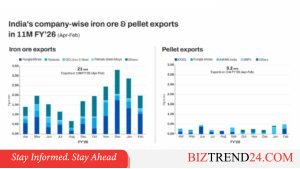
According to provisional data with BigMint, India exported around 2.48 million tonnes (mnt) of iron ore and pellets in February 2026 compared with 3.3 mnt in January 2026.
Of the total shipments, iron ore accounted for 1.99 mnt, declining 31% m-o-m, while pellet exports stood at 0.49 mnt, increasing 16% m-o-m, during the month.
India exported around 1.93 mnt of iron ore and pellets to China during the month, though the volume recorded a sharp 40% m-o-m decline as Chinese steel mills scaled back procurement ahead of the Lunar New Year holidays.
Key factors behind lower exports in Feb’26
Chinese procurement slows amid Lunar New Year: Chinese steel mills slowed raw material purchases ahead of the nine-day Lunar New Year holidays (15-23 February), a period when industrial activity in China typically declines. By early February, most major mills had completed restocking, leaving only sporadic inquiries.
At the same time, subdued domestic steel demand in China further dampened buying interest for seaborne iron ore cargoes, including those from India. Chinese buyers also delayed purchases, expecting price corrections, while bid-offer gaps also emerged, especially for pellet cargoes.
Portside inventories in China rise slightly m-o-m: Iron ore and pellet inventories at Chinese ports also increased during the month, reducing the need for fresh imports. Portside inventories rose 1% to 163.39 mnt in February 2026, compared with 161.24 mnt in January 2026, indicating comfortable stock levels at major receiving ports. Higher inventories reduced import demand and weighed on seaborne prices.
Miners’ ECs near exhaustion, limiting export supply: Production constraints at several mines in India also affected export volumes. Many Odisha-based iron ore mines had approached their FY’26 environmental clearance (EC) production limits in February. With order books already filled and EC limits nearing exhaustion, export supply tightened, which also slowed exports m-o-m.
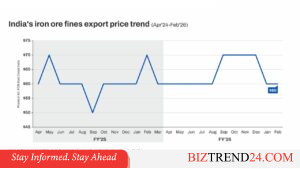
Export realisations decline: Exporters’ margins also shrank during February. FOB prices of Indian low-grade iron ore fines (Fe 57%) declined to an eight-month low of $62/t in February 2026 from around $67/t in January 2026. This follows a $7/t (7%) m-o-m drop in the Chinese iron ore (Fe 61.5%) fines prices to $100/t CNF in February. Pellet export prices, FOB eastern coast of India, fell $9/t (8%) m-o-m to a six-month low of $97/t.
The fall in global iron ore prices compressed exporters’ margins by roughly INR 250-400/t ($3-4/t) across grades, discouraging aggressive export sales and further dampening sentiment in the market.
Additionally, many producers avoided fresh export bookings in late February, preferring to sell into the domestic market where prices remained firm. BigMint’s Odisha Fe 62% iron ore fines index was unchanged m-o-m at INR 5,900/t ($64/t) ex-mines in February. PELLEX, tracking domestic pellet prices in Raipur, increased by INR 700/t ($8/t, 7%) m-o-m in February.
Moreover, as domestic iron ore prices in eastern India remained firm, miners kept offers unchanged, leading to stable procurement costs for exporters. This, coupled with softening export prices, further squeezed exporters’ margins and made overseas sales less workable.
For iron ore, domestic prices exceeded export realisations by around INR 300/t ($3/t) at the start of the month, with the gap expanding to around INR 650/t ($7/t) by the end of February. Meanwhile, domestic pellet prices exceeded export realisations by around INR 1,350/t ($15/t) at the start of the month, and the spread increased to around INR 1,600/t ($17/t) by the end.
Outlook:
BigMint expects iron ore exports to remain subdued in March unless Chinese steel demand improves significantly and global prices rally.
While Chinese procurement typically picks up after the Lunar New Year, the current high inventory levels and uncertainty in China’s steel sector could continue to limit import demand. At the same time, domestic factors such as EC restrictions and stronger consumption by Indian steel mills during the fiscal year-end may tighten the export availability.