

China’s crude steel output drops over 4% in 2025, remains well below 2020 peak

-
- 2025 crude steel output held down by capacity controls, weak demand
-
- Major provinces record declines on structural shift in capacity management
-
- Trade restrictions to imepede China’s exports-led production growth in CY’26
Morning Brief: Full-year crude steel production in China in calendar year (CY) 2025 remained well below the 2020 peak, with annual output coming in at 961 million tonnes (mnt) level, nearly 10% lower than the record high of 1,065 mnt touched five years ago, and about 4.4% lower compared to CY2024. Industry and province-level data indicate that output continued to moderate amid capacity controls, weaker construction demand, and margin-driven production discipline.

China’s steel sector has now recorded multiple consecutive years of production below its peak level, marking a break from the earlier expansion phase. The decline since 2020 has been gradual and policy supported, with regulators continuing to stress overcapacity control, environmental compliance, and orderly production. Annual output has remained below 1 billion tonnes, reinforcing that peak production levels have not been revisited.
Production trend since 2020 peak:
Crude steel production increased steadily through the late 2010s, supported by property investment, infrastructure spending, and export competitiveness, before peaking in 2020 at above 1 billion tonnes. Output has trended lower since then, with each subsequent year recording reduced volumes versus the peak.
Unlike earlier downturns in steel production that reversed with stimulus support, the current reduction reflects policy constraints and softer end-use demand. Industry analysis characterises the shift as managed supply adjustment rather than short-term disruption.
Province-wise production:
Full-year provincial data for 2025 shows that most major steel producing regions recorded lower output compared with 2024, indicating that production cuts were widespread across key clusters. National output declined 4.4% y-o-y, driven by reductions across several top producing provinces, according to the province dataset.
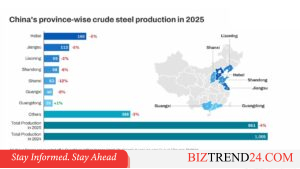
Among the largest producers, Hebei recorded the biggest absolute decline in tonnage, with output down 4.8% y-o-y to about 190 mnt, as environmental restrictions and capacity discipline reduced operating rates. Output in Jiangsu output 3%, while Shandong recorded a decline of about 6%. Liaoning posted a smaller reduction of 2.7%, indicating relatively steadier utilisation.
Inland and northern regions recorded sharper contractions. Output in Shanxi dropped about 12% y-o-y, registering the steepest decline, reflecting lower run rates and tighter controls on inland production.
Only Guangdong recorded a rise in output of about 1%, a rise that was not significant enough in volume terms to offset declines across the main steelmaking regions.
Policy discipline and margins drive output decisions:
Capacity control policy remained a key factor shaping production in 2025. Regulatory guidance continued to discourage aggressive volume expansion and price competition, while reinforcing capacity replacement rules and tighter project approvals. Environmental compliance requirements and regional pollution controls also constrained operating rates in several producing clusters.
China has tightened steel capacity controls through its replacement policy, with regulators moving toward stricter rules that require at least 1.5 tonnes of old capacity to be retired for every 1 tonne of new capacity added in approved swaps, alongside regional bans on new capacity additions in key steelmaking clusters. Authorities also paused the earlier swap approval system in 2024 to revise it with tighter thresholds, reflecting a policy shift from managed replacement to stricter net capacity restraint.
Industry survey data show that blast furnace additions have slowed and are being offset by closures. In 2024, about 22 new blast furnaces were commissioned with roughly 33.3 million tonnes of ironmaking capacity, while 42 furnaces totalling about 34.7 mnt were decommissioned, resulting in a net reduction in BF capacity.
For 2025, around 18 new blast furnaces representing about 26.1 mnt of capacity were scheduled to come online, compared with 22 exits totalling about 16.4 mnt, indicating that new BF additions remain limited and largely tied to replacement rather than expansion under the swap regime.
Mill production decisions were increasingly linked to margins rather than market share. Fluctuations in finished steel prices and raw material costs led many producers to adjust utilisation instead of maximising throughput. Margin-led operating discipline contributed to the mid-single digit year on year decline in national output.
Demand weakness and export strength:
Domestic steel demand remained weak through 2025, mainly due to slower construction activity and continued stress in the property sector. Infrastructure and manufacturing demand provided support but did not fully offset lower real estate consumption, keeping apparent demand below the previous year.
Chinas internal steel demand mix continued to shift in 2025 as the property sector downturn reduced construction-related consumption. Industry reporting shows that rebar’s share in total finished steel output fell to about 13% in 2025, down from roughly 23% in 2019, reflecting a sustained drop in construction steel use. The World Steel Association projects China’s apparent steel demand to decline about 2% in 2025 and ease a further 1% in 2026, with the fall mainly linked to weaker housing starts and lower real estate investment.
By sector, construction and property now account for roughly 5055% of China’s total steel demand, down from near 60% at the previous peak, while non-property sectors account for about 4550%. Within this, manufacturing demand contributes around 3035%, infrastructure about 1520%, and the rest comes from sectors such as machinery, transport equipment, and consumer durables.
Exports reached record levels and helped absorb surplus supply, supported by competitive pricing. However, rising trade measures and import restrictions in several markets limited the extent to which export growth translated into higher domestic production.
Outlook:
Crude steel production in China has moved into a lower operating range, with output about 10% below the 2020 peak and unlikely to return to record levels in the near term with policy continuing to favour capacity control and profitability, according to BigMint analysis. We expect production to remain flat to lower in 2026 as property and construction demand stays subdued and policy continues to emphasise capacity control, emissions compliance, and orderly supply rather than growth in tonnage.
Market outlooks point to a modest improvement in steel demand outside China, led by India and parts of Southeast Asia, alongside steady infrastructure spending in some developed markets. That external demand growth may support global steel balances, but it is not expected to trigger a meaningful rebound in Chinese output. At the same time, rising trade protection measures in several importing regions are likely to cap export-led production upside for Chinese mills.