
India’s steel exports rise 4% y-o-y in CY’25; shipments hit 4-year high in H2

-
- Finished flats exports dip 1%, semis surge 48% on US, UK intake
-
- Exports to EU slide by 7% despite sharp CBAM-driven rebound in H2
-
- Indian exporters target Vietnam as demand from EU starts to wane
Morning Brief: India’s steel exports (including stainless steel) climbed up by 4% y-o-y to 8.59 million tonnes (mnt) in CY’25, as per provisional data with BigMint.

The minor 4% increase y-o-y also marks a sharp turnaround from the first half of the year, during which export volumes were down by 25% y-o-y. The second half of the year saw shipments jump by 47% y-o-y to 4.96 mnt, as EU-based importers accelerated procurement ahead of the start of the definitive period of the Carbon Border Adjustment Mechanism (CBAM).
In fact, the H2 total marks a four-year best for India, that is, the highest since H2CY’21, while the full-year volume failed to match the 8.85 mnt of CY’23. However, the slight rise can be considered a cause for cheer, as it occurred despite China’s massive export flood, whose volumes rose 7.5% y-o-y to an all-time high of 119 mnt in CY’25.
Aggressively low pricing continued to boost China’s volumes despite strong pushback from major importers. This partially contributed to India’s weak momentum in the global export arena.
Notably, semi-finished steel shipments increased by 48% y-o-y, emerging as a key driver of the 4% uptick in the CY’25 total as finished flat steel exports witnessed a marginal correction. Higher exports to the UK and US contributed to the sharp increase in semi-finished steel volumes.
Region-wise exports:
Overall, shipments to the EU, India’s largest export destination, fell by 7% in CY’25 despite surging by 90% y-o-y in the second half of the year. Among other leading destinations in CY’25, exports to the UAE increased by 25%, Nepal remained stable, the UK fell by 9%, the US jumped by 96%, Vietnam rose 94%, and Saudi Arabia plunged by 79%.
Commodity-wise break-up:
Among carbon steel export categories, finished flats edged down by 1% y-o-y, with hot-rolled coils (HRCs) registering a slight drop of 4% (2.43 mnt). Pipes and tubes exports increased by 21% (1.92 mnt), galvanised steel was down by 27% (1.01 mnt), and cold-rolled coils (CRCs) rose 17% (0.59 mnt).
Semi-finished steel shipments increased by 48%, while finished longs exports grew 12%. Stainless steel volumes remained stable y-o-y.
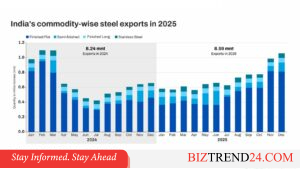
Key export trends in CY’25
UK, US shipments drive up semis exports: India’s semi-finished steel exports surged as shipments to the US and UK doubled, while Nepal maintained stable imports y-o-y. In the UK, tight supply and elevated energy costs prompted rerollers and sections mills to import billets. Media reports also suggest that Tata Steel UK began to import steel slabs, as well as coils, from its Indian and Dutch facilities following the closure of its blast furnaces at Port Talbot in September 2024.
US EAF producers and traders occasionally sourced Indian semi-finished steel, especially billets, due to two reasons primarily: First, FOB India levels were competitive versus CIS material that faced higher geopolitical and sanctions risk. Secondly, a strong US dollar and relatively weak rupee improved landed cost economics for US buyers on a spot basis.
Nepal continued to anchor India’s billet exports due to limited raw material availability and freight and logistical advantages (low transport costs, short lead time, and established credit relationships). Western and central India struggled with surpluses due to muted domestic longs demand during the monsoon, so mills pushed more material into Nepal via shorthaul road/rail.
Exports to EU shrink on lacklustre manufacturing activity: Subdued automotive and construction activity weighed on steel demand in the EU. The region struggled with geopolitical uncertainty, especially due to the US tariffs, elevated energy costs, and a broader economic slowdown, which failed to alleviate despite periodic monetary easing. In its December 2025 quarterly outlook, EUROFER projected that apparent steel consumption would decline by 0.2% in CY’25. This stagnancy in steel demand ultimately dragged down India’s steel exports to the EU last year despite CBAM-driven front-loading in H2. Low-priced shipments from competitors such as Indonesia also ate into India’s market share.
Additionally, exports were slow before March, as the import market waited for the results of an anti-dumping investigation into HRCs from India, among other countries. Activity accelerated after the European Commission concluded in mid-March that no dumping took place from India during the assessment period.
In terms of commodities, HRC exports to the EU fell 12% (1.30 mnt) and galvanised steel shipments (0.82 mnt) were down 27%. Additionally, while CRC exports increased 27% (0.56 mnt), the EU also initiated an anti-dumping investigation into rising imports of the same from India, besides Japan, Turkiye, Vietnam, and Taiwan.
HRC exporters turn to Vietnam as EU deals dry up: In Q4CY’25, Indian exporters stepped up shipments to Vietnam as EU-based importers adopted a wait-and-watch stance. This caution stemmed from the lack of clarity regarding potential CBAM carbon costs and the exhaustion of India’s HRC safeguard quota well ahead of schedule.
Weak domestic demand in India also pushed mills to use exports as an outlet to offload excess supply. Meanwhile, a depreciating rupee allowed exporters to reduce their offers to attract buyers while ensuring sufficient margins.
To illustrate, BigMint’s HRC export index for the Middle East and Southeast Asia fell 5% q-o-q to $480/tonne (t) in Q4, a divergence from the softer 2% drop in Chinese offers to $465/t FOB. Chinese HRCs also remained out of favour during this period due to an investigation into potential Chinese circumvention of Vietnam’s anti-dumping duties. India, however, was cleared of HRC dumping charges following an investigation concluded in February 2025.
Exports to Middle East show mixed momentum: Shipments to the UAE increased by 25%, led by significantly higher purchases of HRC/plates and pipes and tubes. Meanwhile, exports to Saudi Arabia declined by 79%, as India’s pipes and tubes shipments to the country tapered off from September 2024.
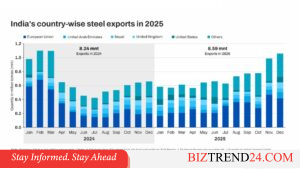
Outlook:
India’s export momentum is likely to soften in the first quarter of CY’26. India has fully utilised its Q1 EU HRC quota, meaning that further exports to the region are likely to bear a 25% tariff in addition to the CBAM costs that are to be paid for later. This may keep EU-based importers cautious about sourcing from India, especially with reference to HRCs. A potential India-EU trade deal may offer relief, though it is still unclear if EU will allow relaxations on CBAM.
As for alternative markets, mills seem to be exploring Vietnam and Nepal at least with reference to HRCs. Rising export restrictions on Chinese steel in Southeast Asia could also provide mills with better leverage, while the absence of Chinese market participants during the Lunar New Year holidays could also provide them with a window of opportunity. However, these smaller destinations may not be able to absorb the excess supply that may emerge due to the loss in export momentum to the EU. Improving price realisations in the Indian market during Q1 may keep mills focus on Indian sales.