

China weekly: Steel prices edge higher w-o-w on raw material support, gains in SHFE futures

-
- Positive macroeconomic outlook, firm restockingfuel iron ore price hike
-
- Met coke market remains weak as steel mills make cautious purchases
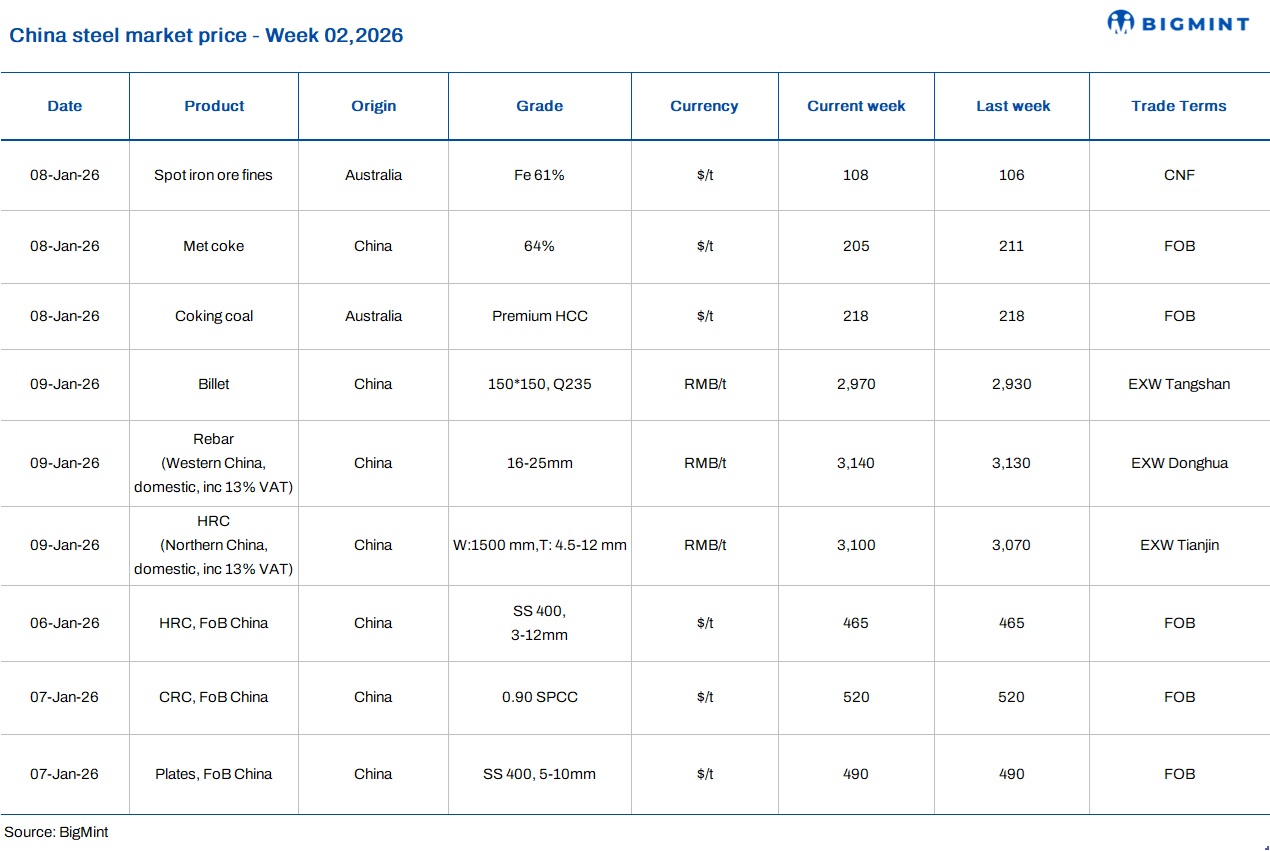
Chinas steel prices edged higher this week, supported by gains in SHFE futures and higher raw material costs. Domestic hot-rolled coil (HRC) and rebar prices rose marginally w-o-w. Raw materials, including iron ore and billets, also recorded marginal gains, while coking coal prices remained stable w-o-w.

The China Iron and Steel Association (CISA) reported that total steel inventory at key Chinese enterprises reached 14.14 million tonnes (mnt) in late-December 2025 (21-30 December), a decline of 1.87 mnt or 11.7% against 16.01 mnt in mid-December 2025.
Baosteel, the worlds leading steelmaker, has kept its HRC prices unchanged for February sales compared with January deliveries, supported by steady SHFE HRC futures m-o-m. However, it has raised March prices by RMB 100/t ($14/t) m-o-m. Prices of hot-dip galvanised products also remained stable m-o-m for February, while March prices were increased by RMB 100/t ($14/t) m-o-m.
1. Iron ore spot prices rise w-o-w: Iron ore fines (Fe 61%) benchmark prices edged up by $2/t to $108/dmt CFR China on 8 January against 2 January. The increase was driven by a positive Chinese macroeconomic outlook and firm restocking ahead of the Lunar New Year. Higher blast furnace utilisation, tighter mill inventories, and supportive coking coal futures further boosted the market, with participants noting strong procurements in recent weeks.
Iron ore inventories at major Chinese ports stood at 153.86 mnt on 8 January 2026, increasing by 3.31 mnt w-o-w, as per data published by SteelHome.
a) Spot pellet premium remains stable w-o-w: The spot pellet premium for Fe 65% grade pellet remained firm at $17.8/t CFR China on 7 January.
b) Spot lump premium drops w-o-w: The spot lump premium edged down w-o-w to $0.050/dmtu on 9 January.
2. Chinas met coke market remains weak: Chinas domestic coke market remained weak and steady, as steel mills continued to adopt a cautious procurement approach in response to subdued downstream demand. While coking enterprises experienced margin pressures and adjusted production levels flexibly, reductions in supply did not keep pace with the slowdown in demand, contributing to the overall market softness.
On the cost side, Australian premium hard coking coal (PHCC) prices held steady at $218.5/t FOB, whereas BigMint’s premium hard coking coal (PHCC) index increased by $2/t w-o-w, reaching $238/t CNF Paradip on 9 January 2026. Global coking coal prices may remain supported due to weather disruptions in Australia.
3. Chinese billet prices rise by RMB 40/t w-o-w: Billet prices opened the week at RMB 2,930/t ($419/t) on 2 January and settled at RMB 2,970/t ($425/t) on 9 January, higher slightly by RMB 40/t ($6/t) w-o-w.
The market remained quiet early in the week due to the New Year holiday, with muted trading and stable prices. Sentiment improved mid-week as a sharp rally in iron ore, a jump in coking coal and coke futures, mill price hikes, and speculative buying lifted billet prices to RMB 2,980/t ($427/t) on 7-8 January.
However, gains proved unsustainable, with prices easing on 9 January amid weak winter demand, rising inventories, and export and logistics disruptions.
SHFE rebar futures showed higher volatility but ended nearly flat. Prices rose just RMB 5/t ($1/t) w-o-w from RMB 3,103/t ($444/t) on 2 January to RMB 3,108/t ($445/t) on 9 January. Early-week pressure reflected cautious futures trading and balanced winter demand-supply, while the sharp mid-week surge was driven by higher raw material costs and stronger export benchmarks.
The late-week correction reflected persistent concerns over weak domestic demand, rising social inventories, and the absence of clear policy support, keeping overall sentiment cautious despite firm cost-side support.
4. Domestic HRC prices inch up w-o-w: Domestic HRC prices in China inched up by RMB 30/t ($4/t) w-o-w to RMB 3,100/t ($444/t) on 9 January from RMB 3,070/t ($440/t) on 31 December 2025, following a rise of RMB 19/t ($3/t) w-o-w in the SHFE HRC futures (May 2026 contract) to RMB 3,293/t ($472/t) on 9 January from RMB 3,274/t ($469/t) on 31 December.
However, Chinas HRC export offers remained unchanged w-o-w at $465/t FOB on 6 January 2026, as persistently global weak demand continued to limit any upward momentum in prices.
5. Rebar prices rise w-o-w: Chinas rebar prices edged up by RMB 10/($/t) w-o-w to RMB 3,140/t ($/t) on 9 January from RMB 3,130 ($/t) a week earlier, tracking gains in SHFE futures. The SHFE futures (May 2026 contract) inched up by RMB 19/t ($3/t) w-o-w to RMB 3,146/t ($451/t) on 9 January from RMB 3,127/t ($448/t) on 31 December 2025. However, overall demand in the region remained weak, with no meaningful improvement in the market activity.
Outlook:
Chinas steel prices are expected to remain mixed in the coming week, with any further upside largely dependent on a meaningful pick-up in demand. While firmer futures provide some support, raw material prices remain mixed. Market sentiment is expected to remain cautious until clearer signs of demand recovery emerge.