
India’s iron ore imports hit 7-year high in CY’25 as production lags behind demand

-
- India resumes pellet imports after nearly 4-year hiatus
-
- 25% drop in iron ore output drives JSW to double imports
-
- Material shortages keep Indian prices firm, global prices fall
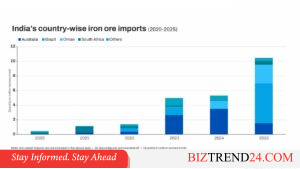
Morning Brief: India’s iron ore imports stood at 12.2 million tonnes (mnt) in CY’25, as per provisional data maintained with BigMint. Of this, 10.4 mnt comprised fines and lumps, almost doubling y-o-y (+97% y-o-y), while pellets accounted for 1.8 mnt, a manifold surge from just 0.06 mnt.

This is the highest annual import volume since 2018 and only the third instance when imports crossed the 10 mnt mark. In 2018, India’s iron ore imports reached 16 mnt, following mining suspensions in Odisha, which constrained domestic availability.
Similarly, in CY’25, limited iron ore production in the face of rapid growth in crude steel output led to a surge in imports. Pellet imports also resumed after a pause of nearly four years, triggered by competitive pricing, quality requirements, and regional supply shortages.
Notably, while India’s crude steel production climbed up by 10% y-o-y to 164 mnt, iron ore output increased by a minor 4% y-o-y to 294 mnt during CY’25, pointing to a supply-demand mismatch.
Major importers:
Among iron ore importers, JSW Steel remained the largest buyer, importing 9.9 mnt during CY’25 — a 112% increase y-o-y, which was the primary contributor to the sharp uptick in India’s total. JSW imported solely fines/lumps, accounting for 96% of India’s total imports of the same.
Other major buyers included Suryadev (0.28 mnt), Delta Global (0.19 mnt), and BMP Steel (0.15 mnt), importing solely pellets.
Source countries:
On the supply side, Brazil exported 5.46 mnt, comprising only fines/lumps, to India in CY’25 compared to nil in CY’24. Ponta Da Madeira, a private port operated by Vale, handled 4.60 mnt. The remaining 0.86 mnt was shipped from Tubarao Port.
Oman exported 4.14 mnt to India, consisting of 2.5 mnt of fines/lumps and 1.63 mnt of pellets. Oman supplied 92% of India’s pellet imports, with the rest arriving from the UAE. Meanwhile, Australia supplied 1.53 mnt of fines/lumps, a 56% decrease y-o-y, and South Africa delivered 0.50 mnt, with volumes being exponentially higher y-o-y.
Overall, Brazil led shipments with supply of high-grade, low-gangue ore, which blends efficiently with domestic material. On the other hand, Oman largely functioned as a transshipment hub, re-routing Iranian-origin cargoes, as per market participants.
Factors influencing iron ore imports in CY’25:
JSW’s production plunges post Jajang mines surrender: JSW Steel’s iron ore production fell by 25% y-o-y in CY’25 to 19 mnt (provisionally) against 25.4 mnt in the previous year, following the surrender of its Jajang mines in Odisha, announced in August 2024. This production loss was evidently compensated for through imports.
India faces shortage of high-grade ore: In CY’25, although India’s iron ore supply exceeded consumption (282 mnt versus 272 mnt, respectively, as per provisional data), there was a shortage of high-grade Fe 62% ore, which is for used blast furnace-based steelmaking in India.
In the face of growing steel consumption and production, the sustained delay in the operationalisation of a vast majority of auctioned mines (101 out of 138) tightened the supply of high-grade ore. As such, Indian steelmakers had to source material overseas.
Additionally, given the 9% fall in global benchmark prices, Indian steelmakers took this opportunity to procure Brazilian iron ore, which is more suitable for efficient sintering and blast furnace operations. Notably, Brazilian ore contains lower levels of gangue, especially alumina and silica, than Indian material.
Similarly, high-grade (Fe65%), low alumina (max 1%) pellets were available for imports at competitive prices, which are not easily obtained in the domestic market. Indian producers typically offer Fe 62.5-63% pellets.
Logistical constraints limit easy material access: The shortage of adequate iron ore material was exacerbated by transportation challenges such as elevated, complex freight costs. This limited the delivery of pellets from central to western India and prompted west coast-based mills to source from the Middle East.
Global iron ore prices fall while domestic ones increase: Import prices remained favourable in CY’25, supported by softer seaborne offers and lower Chinese iron ore fines prices.
South African iron ore lumps prices (CNF Kandla) declined by 4% to an average of $113.8/tonne (t) in CY’25, keeping landed costs favourable for Indian steelmakers. Conversely, domestic lumps prices climbed up by 10% y-o-y to INR 7,440/t ($83/t) ex-mines Odisha. The share of lumps in India’s iron ore production was estimated at 27% in CY’25 against 30% in CY’24, indicating shrinking availability despite India’s growing sponge iron production.
Imported pellet prices at Kandla averaged around INR 10,460/t DAP in CY’25, lower by 7% than INR 11,280/t DAP in CY’24, keeping imports attractive due to firm prices in central India, tight regional supply, and high inland freight costs. PELLEX, BigMint’s pellet index for Raipur, edged up by 3% y-o-y to INR 9,850/t DAP.
Outlook:
Iron ore imports may continue in 2026 due to expanding steel and sponge iron production capacity and stagnant domestic mining. However, industry reforms to boost supply may slow down the pace of arrivals, though the lack of policy direction till now indicates that supply dynamics will not improve anytime soon.
Global iron ore prices are expected to head south further in CY’26 due to a supply pressure, which could support import sourcing. Meanwhile, tight supply may keep Indian prices firm. Consequently, driven by depleting iron ore reserves and grade quality, imports are expected to become a staple feature of India’s trade flows.