
India: What will be final price impact of safeguard duty on steel imports?

-
- Domestic HRCs cheaper by INR 5,000/t than imported material
-
- Safeguard duty, improved demand to keep domestic prices firm
The Directorate General of Trade Remedies (DGTR) has officially implemented a definitive safeguard duty on imported non-alloy and alloy steel flat products to protect the domestic steel industry. The duty is scheduled to remain in effect for three years and applies retrospectively, beginning from the original provisional start date of 21 April 2025.

This measure encompasses a wide array of flat steel categories, specifically targeting products such as hot-rolled (HRCs) and cold-rolled coils (CRCs), sheets, and plates, as well as metallic and colour-coated steel. These items are classified under several tariff headings of the Customs Tariff Act, 1975, including 7208, 7209, 7210, 7211, 7212, 7225, and 7226. By implementing these duties, the government intends to stabilise the market and ensure a level playing field for the nation’s steel manufacturing sector.
Safeguard duty tiers:
Under the notification, the safeguard duty has been structured on a declining scale:
-
- 12% ad valorem from 21 April 2025 to 20 April 2026
-
- 11.5% from 21 April 2026 to 20 April 2027
-
- 11% from 21 April 2027 to 20 April 2028
However, the said safeguard duty shall not be levied for the period commencing from the date of the lapse of the provisional safeguard duty up to the preceding day of the publication of the notification in the official gazette.
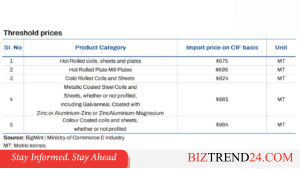
The threshold import price of hot-rolled coiled sheets and plates on CIF (cost, insurance and freight) basis has been pegged at $675/t. For hot-rolled plates, the value is $695/t, for cold-rolled $824/t, and for metallic, coated steel, and others at $861/t. The threshold import price for colour-coated coils and sheets, whether or not profiled, is $964/t.
Estimated increase in landed prices post-safeguard imposition:
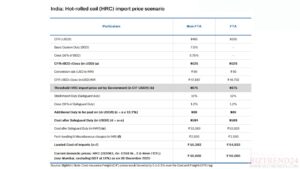
BigMint has calculated the impact of the 12% safeguard duty on HRCs, which is the largest category that gets imported into India, from both FTA and non-FTA countries. The CFR price of HRCs from non-FTA countries is taken at $485/t on 31 December with 7.5% basic customs duty plus 0.75% of cess at 10% of the BCD, which takes the price to $525/t. With the Indian rupee (INR) conversion rate taken at 90 to the dollar, it works out to INR 47,182/t.
The 12% safeguard duty, along with a cess of 1.2% (10% of the safeguard duty), works out to $69/t. Therefore, post-safeguard duty, the cost is estimated at $594/t ($525/t + $69/t) or INR 53,383/t ($650/t). With the addition of INR 2,000/t ($22/t) as port handling charges, the total landed cost of HRC imports is calculated at INR 55,383/t.
On the other hand, currently, domestic benchmarked trade-level HRC prices (IS2062, Gr-E250 Br., 2.5-8mm/CTL), ex-Mumbai and minus 18% GST, were around INR 50,000/t ($556/t) on 31 December, making these cheaper by around INR 5,000/t ($56/t).
The final landed cost of HRC imports from FTA countries works out to INR 54,933/t ($611/t), slightly lower than those of imports from non-FTA countries.
Domestic price hike expectations:
Domestic trade-level HRC prices (IS2062, Gr-E250 Br.) ex-Mumbai saw a significant uptick during December 2025. Prices climbed by approximately INR 4,000/t ($44/t), rising from INR 46,000/t ($512/t) on 1 December to roughly INR 50,000/t ($556/t) on 30 December.
Market participants anticipate this upward momentum to persist. In the immediate short term, trade prices are projected to increase by another INR 1,000-1,500/t ($11-17/t), driven by continued input cost pressures and the recent implementation of definitive safeguard duties.
Outlook:
Indian HRC prices are likely to stay firm with a positive bias in the near term, supported by an INR 4,000-5,000/t premium on imports after the safeguard duty, which has restricted flat steel inflows. Improved mill order books amid stronger manufacturing activity and trade-led restocking in the final quarter of the fiscal year are likely to further support prices and tighten the demand-supply balance.