
China’s crude steel production to drop below 1 bnt in CY25 for first time in 6 years

-
- Crude steel output drops to around 892 mnt in 11MCY’25
-
- Steel demand projected to fall by over 5% y-o-y in CY’25
-
- Steady decline in steel prices, profits to weigh in Q1CY’26
Morning Brief: In what would surely count as an historic achievement in restoring global steel industry balance, China’s crude steel production is expected to fall below the 1 billion tonne (bnt)-mark for the first time in six years in 2025. Data compiled by BigMint show that production in the January-November 2025 period (11MCY’25) stood at around 892 million tonnes (mnt), a decrease of 4% y-o-y. In volume terms, this was around 37 mnt lower than the same period last year.

As per Chinese government projections, crude steel output is expected to fall to around 970 mnt in CY’25. Although Chinese authorities tentatively suggested a target of 50 mnt of production reduction in the beginning of the year, volumes vacillated through the months. Understandably, the authorities shied away from a strict enforcement due to considerations related to local employment and the health of provincial economies so intricately tied with steel industry fortunes.
Province-wise production:
Northern China, especially the Beijing-Tianjin-Hebei belt, has the largest concentration of steel mills in the country and bears the brunt of environmental regulations more than the other steel producing regions. Crude steel production in Hebei dropped 4% y-o-y while Jiangsu in East China, the second-largest steel producing province, saw a decline of 5% in production.
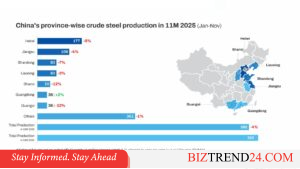
All the major provinces saw production declining save Guangdong in South China where newer capacities are coming on stream, not to mention the logistical and clean energy advantages that accrue to the province in comparison with the traditional manufacturing bases in the North and East of the country.
Why did steel output shrink in 11MCY’25?
Declining consumption: Steel consumption in China will reach around 808 mnt in 2025, down 5.4% y-o-y, according to the China Metallurgical Industry Planning and Research Institute (MPI), which is a clear indication of demand dropping at a faster pace than production. Investment remained the main structural drag, with fixed asset investment falling 2.6% y-o-y in 11MCY’25. Private investment declined 5.3% and real estate development investment decreased nearly 16% y-o-y, reinforcing the view that the property sector slowdown is the key reason for declining steel demand. This year, according to MPI estimates, steel consumption in the construction sector has fallen by almost 13% to 400 mnt.
Notably, in 2000, China consumed around 124 mnt of steel, which was roughly on a par with the US but lower than the 168 mnt consumed in the EU. By 2020, China was consuming over 1 bnt annually, while the EU’s steel use had fallen to 131 mnt. This was not because the GDP per capita of the Chinese economy usually considered the main yardstick of steel demand had surged above the EU but that the steel intensity of the Chinese economy (predominantly based on hardcore infra and construction) is still way higher than developed economies.
Now, with the share of the infra and construction in steel demand falling from over 60% earlier to around 35-40% currently, China’s steel production is naturally under severe strain. The share of exports in CY’25, for instance, has climbed to around 12% of total production from roughly 7% earlier, underlining continued demand downtrend.
Policy thrust: The 20252026 Steel Industry Growth Plan, jointly issued by the Ministry of Industry and Information Technology (MIIT), the Ministry of Natural Resources, the Ministry of Ecology and Environment, the Ministry of Commerce, and the State Administration for Market Regulation on 22 September last, calls for a break away from the inertia of scale expansion stressing instead on value-addition and the need to halt capacity addition.
Earlier in the year, the government’s ”anti-involution” policy was a clear message to steelmakers to maintain production discipline. Regulatory actions on consolidation of the giant state-backed enterprises and mothballing of technologically obsolescent, small enterprises are ongoing.
Moreover, winter pollution cuts and environmental measures have played no small a part in restricting production, especially in Northern China. Local authorities in Tangshan have intermittently mandated production cuts since August. These measures are aligned with the goal of curtailing overproduction.
Tanking profits: Profits across China’s steel industry fell by 42.6% y-o-y to RMB 66.3 billion ($9.3 billion) in 2024, leaving many firms in negative territory. The average operational rate among steel mills sampled by intelligence provider Mysteel shows a downtrend because of the sustained decline in steel mill profits in the backdrop of declining prices as well as firming up of global coking coal and iron ore prices. For example, domestic HRC prices (exw Tianjin) declined by 8% in December compared to January and around 5% vis–vis August levels.
According to Mysteel, more BF mills are reining in production because they are suffering deeper losses. As of 27 November, only around 35% of the 247 BF mills could make some profits on steel sales, lower by 3 percentage points from a week earlier. Squeezed margins naturally weighed on production.
Outlook:
China, accounting for 49% of global demand, is expected to see consumption fall by an average of 5-7 mnt annually over the next decade, according to Wood Mackenzie. This dramatic shift creates significant overcapacity challenges. China’s share in global steel demand is projected to drop sharply from 49% in 2024 to 31% by 2050.
In 2026, demand related to construction sector is expected to decline by 4.1% y-o-y in 2026, to 384 mnt. Sectors such as automotive, shipbuilding and new energy are expected to witness stable growth in the coming year but on a far lower base compared to construction. For perspective, while construction-related demand is still around 400 mnt, demand from the auto sector is just about 65 mnt. This is another area in which Chinese steel demand dynamics contrasts with that of developed countries.
Therefore, in 2026, ongoing production discipline, capacity swaps and closures, as well as decarbonisation efforts may lead to further decrease in Chinese steel production and capacity. However, the decrease may not be significant given that the WSA has projected steel demand decline at 1% in CY’26 compared to 2% in CY’25. A global recovery in steel prices may also impede any quick decline in production. And, despite mounting trade barriers, it remains to be seen if Chinese steel exports will decrease meaningfully enough to pressure the country’s domestic steel production.