
BigMint’s India steel index rebounds before year-end, positive momentum may continue

-
- Tier-1 mills raise HRC list prices after earlier rollover
-
- IF-rebar prices rise across regions, inventories ease
-
- Heightened economic impetus in Q4 may support prices
Morning Brief: BigMint’s India steel composite index, a barometer of domestic steel market movements, edged up by 0.9% w-o-w, as assessed on 19 December 2025, with the domestic Tier-1 mills raising flat steel list prices, currency depreciation raising the landed cost of imports, the induction furnace (IF) steel market witnessing a notable recovery, and domestic iron ore and imported coking coal prices continuing their strong run.

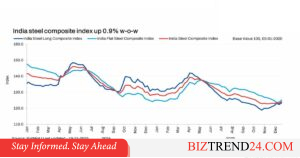
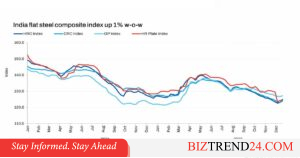
The flat steel index inched up by 1% to reach mid-November levels, while the longs index, supported by a sharp 1.3% w-o-w uptick in the rebar sub-index, reached levels last seen in mid-September.
Highlights of price movements:
Mills raise flats prices: Leading mills raised list prices of hot-rolled coil (HRC) and cold-rolled coil (CRC) by INR 750-1,000/tonnes (t) in the week ended 19 December, after keeping them stable for sales in the beginning of December compared levels prevailing during end-November.
BigMint’s benchmark assessment for HRC (IS2062, Gr E250, 2.5-8 mm/CTL) rose by INR 1,100/t ($12/t) w-o-w to INR 47,100/t ($525/t) on 19 December against INR 46,000 ($513/t) on 12 December. CRC (IS513, Gr O, 0.9 mm/CTL) prices increased by INR 500/t ($6/t) w-o-w to INR 54,200/t ($604/t) on 19 December. These prices are ex-Mumbai for the distributor-to-dealer segment and exclude 18% GST.
BigMint’s assessment for Odisha iron ore Fe62% prices have increased by nearly 8% since the beginning of November as supply remains tight. In OMC’s latest auction, the weighted average premium was around INR 750/t and, despite a 0.5 mnt hike in offered quantity, 97% of the material was sold, indicating firm raw material market conditions.
BigMint’s premium hard coking coal index rose to $238/t CNF Paradip, up $11/t w-o-w on 19 December the highest in one-and-a-half years. As coking coal import dependence accounts for over 90%, prolonged INR weakness can pressure input costs. Currency depreciation is pushing HRC prices by increasing the landed cost of imports and reducing the viability of low-priced foreign steel. This currency-led cost escalation is reinforcing domestic mills’ pricing power.
However, HRC market sentiments remain just about moderately balanced: “In December, arrivals have been low to moderate, supporting price stability across markets in north India,” informed a source. There is no visible demand-driven momentum. In the western region, distributor sources indicated that selective withdrawal of discounts by producers led to a mild firming up of prices.
Secondary rebar prices tick up: IF-route rebar prices edged higher on robust trading activity and sustained buyer inquiries. Adequate order inflows in line with daily production capacities cushioned offers by mills. Inquiries were primarily driven by both project-based and retail consumers. Inventory levels at mills are currently assessed at a balanced 10-12 days across regions.
Trade prices of BF rebar prices moved within a narrow range in the week ending 19 December. Buyer activity saw marginal improvement following early-month price hikes, though distribution channel demand remained subdued. Buyers also showed resistance to higher prices, with the typical gap between bids and offers at INR 400-500/t.
Trade-level BF rebar prices were unchanged w-o-w at INR 47,500/t ($527/t), minus tax, exy-Mumbai, as per BigMint’s assessment on 19 December. In the projects segment, demand weakened due to construction slowdowns and government funding delays, but procurement is expected to pick up as market conditions improve.
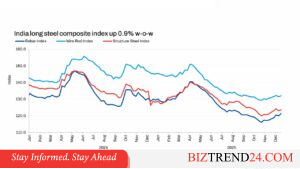
Rebar inventories at mills dropped slightly mid-December, indicating improved dispatches from mills to the project segment rather than a notable recovery in spot demand.
Outlook:
The domestic steel market is entering 2026 amid a lot of uncertainty regarding global demand, trade policies and tariffs and their impact on steel exports. It is expected that the price hike taken by mills for flat products, and the likely hike in BF rebar prices following the uptick in IF steel prices, will be absorbed by the market unlike in November due to a) expectation of seasonally positive market momentum in Q4FY26, and b) strengthening raw materials prices.
However, a lot will hinge on the pace of inventory drawdown in the coming days and the continuation of the current over 7% growth rate in Q4 on the back of heightened fiscal-end economic momentum.