
India remains net steel importer despite shipments dropping 15% y-o-y in Jan-Oct’25

- Steel imports reach around 8 mnt in 10MCY’25
- Exports remain flat y-o-y at around 6.9 mnt
- Lifting of QCOs on key products unlikely to boost imports
Morning Brief: Despite steel imports dropping significantly in January-October 2025 (10MCY’25), India remained a net steel importer, as per BigMint data.

India’s imports of steel products were recorded at around 8 million tonnes (mnt) in 10MCY’25, a decrease of 15% y-o-y, according to latest data. After hitting a 9-year peak in CY’24 of over 11 mnt, India’s steel imports moderated in CY25 due to the implementation of safeguard duty to protect the domestic industry.
Product- & country-wise imports:
Steel imports from the Asian majors -China, South Korea and Japan witnessed a significant decline in 10MCY25. While imports from Korea and Japan fell by 4% and 24%, respectively, steel shipments from China fell even more sharply by over 50% y-o-y. However, imports from Vietnam and other origins increased in 10MCY25.
The sharpest drop was seen in flat steel imports which fell by 27% y-o-y to 5.45 mnt during the review period. While stainless steel imports declined by 10% on the year to around 1.3 mnt, imports of semis increased exponentially owing to sourcing of slabs and semis by a leading integrated steelmaker from its overseas subsidiaries.
Why did steel imports drop in 10MCY’25?
Safeguard duty raises cost of imports: With the implementation of the 12% safeguard duty, landed costs of flat steel imports have remained higher than domestic prices. For example, domestic HRC were cheaper by around INR 7,500/t compared to Chinese imports in terms of landed costs in H1FY26, as per BigMint assessment. The gap widened to INR 8,000/t in early October, due to a steeper decline in domestic prices. Similarly, the landed cost of imports from Japan, too, was higher.
Anti-dumping duties imposed: India has announced anti-dumping duties on HRC from Vietnam and electrical steel from China. In early October, the government initiated an anti-dumping investigation into cold-rolled stainless steel flats originating in China, Indonesia, and Vietnam. These protectionist measures have made buyers cautious about sourcing imports due to higher costs.
Quality regulations: The government has mandated that raw materials used in the manufacturing of imported steel adhere to BIS quality norms. India has also delayed BIS licence renewals of Chinese steelmakers. However, the NITI Aayog has recently proposed the lifting of QCOs (quality control orders) from over 100 steel products. These are engineered steel products, electrical grades, auto parts and components, etc.
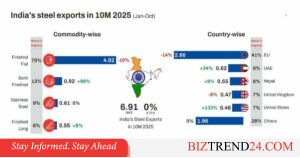
At the other end of the spectrum, Indias exports of steel remained flat y-o-y in 10MCY25 at around 6.9 mnt. However, after a very slow start in the beginning of the year amidst US imposition of tariffs and reciprocal tariffs, exports gathered some momentum from mid-2025 onwards due to buyers in the EU focusing on accumulation of stocks before the implementation of carbon border regulations.
Country- & product-wise steel exports:
The EU, India’s largest export destination, saw a 14% decline in shipments from India. Total steel exports to the EU stood at around 2.8 mnt. However, the UAE witnessed a surge in Indian exports, while front-loading of shipments to the US before new tariffs took effect resulted in a considerable uptick in Indias steel exports.
Flats by far was the most-exported product category at around 4.8 mnt followed, interestingly, by semis at 0.9 mnt. Flats exports dropped 10% y-o-y. Stainless steel exports were flat y-o-y at around 0.6 mnt.
Factors shaping steel exports
Weak global demand: Subdued manufacturing sentiment globally amid high cost of capital, economic downturn in key countries, trade and tariff wars as well as geopolitical crises impacted steel demand and consumption, thereby impacting exports by India.
Exports to EU drop: Indian HRC export offers to the EU remained low as traders grew cautious ahead of impending CBAM regulations. The expected postsummer holiday uptick did not materialize, with European consumer sectors buying less than anticipated.
Strong regional demand in Middle East: Indian HRC exports for the Middle East held steady during the review period, a stability rooted in buoyant regional demand. However, buyers in the Middle East are curbing purchases before fiscalyear close.
Outlook:
The NITI Aayog’s recommendations of doing away with the steel import monitoring cell of the Ministry of Steel (MoS) and removing QCOs from over 100 critical steel products will facilitate necessary imports and the demands of the domestic manufacturing ecosystem. The net result is unlikely to be an increase in imports but rather cost-effective sourcing of necessary materials by local producers. The price differential between landed cost of HRCs from key countries and domestic benchmark prices (under the safeguard regime) will continue to keep imports unviable in the short term.
However, steering into 2026, export prospects look gloomy because of the EUs safeguard mechanism and carbon taxes, as well as growing global protectionism. Growth in the export market for domestic mills will entirely depend on product and market diversification.