
Asian thermal coal market diverges; China’s domestic strength steadies prices while India remains subdued

-
- Australian high-CV coal consolidates, Indonesian command selective premiums
-
- Production quota uncertainty, logistics constraints support Indonesian offers
Asian thermal coal markets entered August on a firmer footing than they did a month ago, but the recovery remains uneven across regions and coal grades. China’s domestic market continued to strengthen through the week ended 31 July, supporting Australian high-calorific-value (CV) coal prices and providing a firmer replacement-cost floor for the region. However, high inventories, weather-related disruptions, and cautious utility buying continued to limit import demand, preventing a broader seaborne rally.

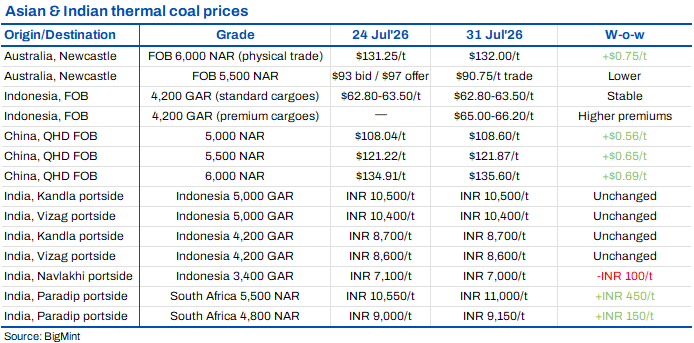
Australian 6,000 kcal/kg NAR coal consolidated around $132/t FOB, Indonesian 4,200 GAR coal remained anchored around $63/t FOB for standard cargoes while premium-quality parcels attracted higher prices, and India continued to rely overwhelmingly on domestic coal as comfortable supplies and the monsoon kept import demand subdued.
The result is a market that is no longer correcting sharply but has yet to find the demand required for a sustained upward move.
China supports prices but not seaborne demand:
China remained the principal source of support for Asian coal markets during the week.
Domestic prices continued their gradual recovery, with the Qinhuangdao (QHD) 5,500 NAR marker increasing to $121.87/t and the 6,000 NAR equivalent reaching $135.60/t. Coastal freights also strengthened further, reflecting improving domestic coal movements.
The recovery was driven by stronger coal burn at coastal utilities, declining inventories at northern loading ports, and tighter mine supply following safety inspections. However, import demand remained restrained. Heavy rainfall and typhoons reduced electricity demand in several provinces, hydro generation improved, and utilities continued drawing on inventories accumulated during earlier summer restocking. Several import tenders were either withdrawn or concluded below sellers’ expectations as buyers maintained strict price discipline.
China has, therefore, become a source of domestic price support rather than a driver of aggressive seaborne imports.
Australian high-CV coal meets resistance:
Australian Newcastle 6,000 NAR coal continued to outperform other seaborne grades but showed signs of consolidation after recovering through July.
A September cargo traded at $132/t FOB, marginally above the previous week’s $131.25/t transaction. However, bid indications ranged widely from $122/t to $134/t, while October offers extended as high as $138/t, illustrating considerable uncertainty over near-term market direction.
Index-linked trading remained noticeably more cautious than the fixed-price market, with buyers continuing to seek discounts to benchmark values. This suggests that although physical prices have stabilised, many participants remain unconvinced that the recent recovery can be sustained without stronger end-user demand.
Australian 5,500 NAR coal appeared softer, with an August cargo changing hands at $90.75/t. While one transaction does not establish a broader market trend, it highlights weaker sentiment for mid-CV coal compared with premium high-CV material.
Indonesian coal develops quality premium:
Indonesia’s low-CV market remained considerably more resilient than demand conditions might otherwise suggest.
Standard 4,200 GAR cargoes continued to trade around $63-63.50/t FOB, broadly unchanged from the previous week. However, low-sulphur material, Sumatra-origin cargoes, and September-loading parcels achieved $65-66.20/t, reflecting increasing differentiation based on quality, origin, and supply reliability rather than a broad market-wide rally.
Production quota uncertainty, stronger domestic market obligations, and logistical constraints continued to encourage producers to defend offers. Nevertheless, subdued Chinese imports and weak Indian buying prevented these supply-side factors from translating into a broader increase across all Indonesian grades.
The market is therefore evolving into a two-tier structure, with premium cargoes attracting higher values while standard material remains anchored near the low-$60s/t.
India remains insulated by ample domestic coal supply:
India continued to provide little support to the regional import market.
Portside Indonesian prices remained largely unchanged during the week, while only South African coal recorded meaningful gains as higher replacement costs lifted offers. Even so, buying remained selective because domestic coal continued to offer a substantial cost advantage.
Thermal power plant coal stocks stood at 38.02 mnt as on 31 July, while 31 thermal power plants remained in the critical category, comprising 24 domestic coal-based and 7 imported coal-based stations. Although inventories have tightened from end-June levels, the stress remains concentrated at individual stations rather than signalling a nationwide shortage.
Coal India’s July production was affected by monsoon-related disruptions, but dispatches remained strong as the miner drew upon pithead inventories to maintain supplies. Consequently, domestic coal continued to meet most industrial and power-sector requirements, limiting the need for imported cargoes despite firmer international prices.
Outlook:
Asian thermal coal has moved beyond the broad correction witnessed in early July, but the market remains driven more by supply discipline than by demand recovery.
China’s domestic market is providing an increasingly firm replacement-cost floor, yet import buying remains measured. Australian high-CV coal has stabilised near $132/t but is encountering resistance from cautious buyers. Indonesian low-CV coal has found support, although premiums are increasingly confined to preferred qualities and deferred-loading cargoes.
India is unlikely to emerge as a significant source of incremental demand while domestic coal remains competitively priced and monsoon conditions continue to moderate industrial consumption.
The market is therefore becoming increasingly segmented. China is supporting regional price stability, Australian high-CV coal is consolidating, Indonesian producers are extracting premiums for quality rather than volume, and India remains largely insulated from seaborne volatility through abundant domestic supply.