

India: HRC prices remain rangebound w-o-w; firm mill pricing limits downside

-
- Market sees balanced supply-demand, not significant oversupply
-
- Premium coking coal prices drop, to support steel mill margins
India’s hot-rolled coil (HRC) prices remained largely rangebound during the week ended 28 July, as balanced domestic market conditions and firm mill pricing offset cautious downstream sentiment. Procurement activity remained largely need-based, with buyers awaiting greater clarity on August pricing announcements from domestic mills.

Trade-level HRC offers were reported at INR 54,600-58,400/t ($570-610/t), while BigMint’s benchmark assessment for HRC (IS2062, Grade E250, 2.5-8 mm/CTL) in Mumbai eased marginally by INR 100/t ($1/t) w-o-w to INR 57,700/t ($602/t) as of 28 July.
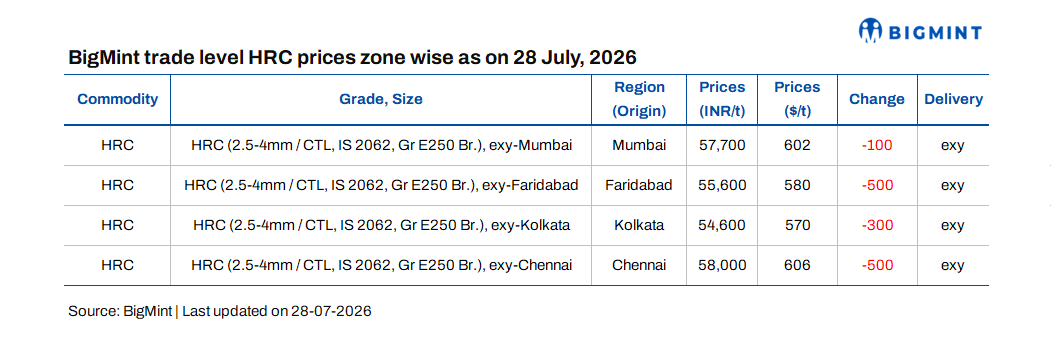
Similarly, BigMint’s benchmark assessment for CRC (IS513, Grade O, 0.9 mm/CTL) declined by INR 100/t ($1/t) w-o-w to INR 64,900/t ($678/t), ex-Mumbai, exclusive of 18% GST.
Balanced market keeps HRC stable:
Domestic HRC trading remained moderate through the week. While downstream demand was not particularly strong, market participants indicated that spot availability too was moderate and not surplus, keeping overall market conditions broadly balanced.
Buyers continued to procure material mainly for immediate consumption, while expectations regarding possible mill rebates or revised August price lists encouraged a selective and cautious approach rather than aggressive restocking.
A trader said that mills have largely maintained firm offer levels, and the market is currently characterised by balanced supply-demand conditions rather than significant oversupply.
Liquidity conditions remained somewhat tight across parts of the steel value chain, influencing trading activity and inventory replenishment decisions. However, firm mill pricing and controlled spot availability helped prevent any meaningful downward pressure on HRC prices.
Overall, the market remained stable, with balanced availability and disciplined mill pricing offsetting the impact of cautious downstream demand.
Mixed raw material trends:
Raw material trends remained mixed during the week, offering limited directional support to finished steel prices.
BigMint’s premium hard coking coal (PHCC) index declined by $7/t w-o-w to $243/t CNF Paradip on 24 July, driven by slower procurement and weak steel demand. Lower coal prices may support steelmakers’ margins if demand improves.
Meanwhile, BigMint’s Odisha iron ore fines (Fe 62%) index rose by INR 50/t w-o-w to INR 4,950/t ex-mines on 25 July. The increase had only a limited impact on HRC prices, as balanced market conditions and cautious buying kept price movements contained.
Anti-dumping duty on met coke boosts cost outlook:
Market participants continued to assess the impact of the definitive anti-dumping duty (ADD) on low-ash metallurgical coke imports from six countries. The duty is expected to raise blast furnace input costs and provide some support to domestic HRC prices.
However, the measure is unlikely to materially affect import volumes immediately, with participants expecting it to influence future import economics more than current trade flows. Any pass-through of higher coke costs to HRC prices will depend on downstream demand conditions.
Imports remain high, domestic availability balanced:
Import arrivals continued to remain elevated. India’s bulk HRC imports reached 261,618 t as of 24 July, with expected arrivals projected at another 137,137 t by 20 August. South Korea, China and Indonesia remained the leading suppliers
South Korea stayed India’s top steel supplier, with much of its HRC shipments tied to long-term agreements for captive use by Korean manufacturers, largely shielding these volumes from short-term market swings and safeguard measures. China’s higher HRC imports, meanwhile, were driven mainly by pipe and tube manufacturers sourcing under the Advance Authorization Scheme for processing and re-export, rather than merchant trading.
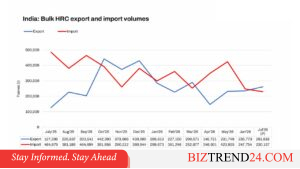
Bulk HRC exports stood at 230,517 t during the same period. Indian HRC export activity stayed weak during the week ended 28 July, with no fresh bookings concluded as buyers awaited clarity on EU tariff-free quota availability and CBAM norms, while geopolitical tensions hit Middle East offers and weak demand pulled down offers to Vietnam.
Outlook:
India’s HRC market is expected to remain rangebound in the coming week, with trading activity likely to stay moderate until mills announce their August price revisions or rebate structure.
Need-based procurement is expected to continue, while firm mill offers and balanced domestic availability may help keep prices broadly stable. Any rebate or price adjustment could trigger limited restocking, but the market is likely to remain cautious, with direction dependent on downstream demand and mills’ pricing strategy rather than concerns over excess supply.