

Asian thermal coal market remains firm w-o-w as Chinese prices inch up, while India remains cautious

-
- Selective restocking lifts Chinese prices but elevated inventories cap gains
-
- Indonesian prices remain flat as weak demand offsets uncertainty around export norms
Asian thermal coal prices remained firm w-o-w in the week ended 24 July 2026, with Australian high-CV coal and China’s domestic prices rising marginally. Indonesian low-CV prices were broadly stable, while Indian portside values also remained firm even as comfortable domestic coal availability, weak industrial demand, and higher freights continued to restrain import buying.

The market can be better described as supply-supported stabilisation rather than a broad demand recovery. China’s domestic prices recovered from their early-July lows, Australian sellers defended higher forward values, and Indonesian availability tightened selectively. However, elevated Chinese inventories and subdued Indian procurement prevented buyers from chasing offers aggressively.
Thermal coal price comparison:
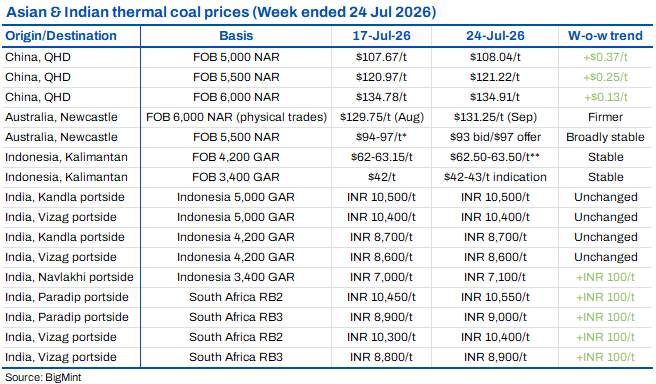
* Includes unconfirmed transactions. ** Excludes a $61/t transaction for 4,100 GAR on a geared-vessel basis, which is not directly comparable with standard 4,200 GAR Panamax cargoes.
China’s QHD markers and coastal freight strengthened during the week, with the 5,500 NAR marker rising to $121.22/t and the 6,000 NAR equivalent to $134.91/t. Freight from Qinhuangdao to Shanghai increased to $5.89/t from $5.25/t, while the Guangzhou route rose to $7.03/t from $6.67/t.
China lends support, but inventories cap recovery:
China’s domestic coal market continued recovering from the lows recorded on 10 July. The improvement was gradual rather than explosive, indicating that stronger coastal movement and selective restocking were supporting prices without creating an outright shortage.
Imported coal tenders also remained active across multiple grades, particularly Indonesian low-CV material. However, high inventories at northern ports and congestion at southern terminals continued to limit buyers’ urgency. The market was therefore supported more by firmer domestic replacement values and improving consumption than by aggressive import procurement.
This distinction matters for the seaborne outlook. China has stopped exerting the intense downward pressure seen in early July, but it has not yet become a sufficiently strong buyer to drive a regional rally.
Australian high-CV coal leads firming trend:
Newcastle 6,000 NAR coal showed the clearest upward movement. An August cargo traded at $129.75/t in the preceding week, while September material traded at $131.25/t during the week ended 24 July. October bids subsequently moved to $133-134.50/t, with offers reaching $135-136.50/t.
However, the physical market remained more cautious than headline fixed prices suggested. September coal traded at a discount of $2.60/t to the index, while bids were heard at discounts of $4-5/t. This indicates that buyers continued demanding protection against a possible correction and that the rise was not backed by uniformly strong prompt demand.
Australian 5,500 NAR coal remained around $93-97/t. The grade has recovered from early-July lows near $91/t but has not displayed the same momentum as premium 6,000 NAR material.
Indonesian coal finds a floor:
Indonesian 4,200 GAR coal remained concentrated around $62.50-63.50/t FOB. Offers extended towards $65-66/t, but buyers showed limited willingness to follow them higher.
The market was balanced between two opposing forces. Export availability was constrained for some grades as miners prioritised domestic deliveries, while uncertainty over production approvals and export arrangements encouraged sellers to defend prices. At the same time, weak Chinese and Indian end-user demand prevented these supply concerns from translating into a meaningful rise.
Indonesia’s strong production performance also limited the immediate shortage narrative. Output reached 367.06 mnt during H1CY’26, equivalent to 61.2% of the country’s 600 mnt annual target, with around 231 mnt exported.
Ultra-low-CV 3,400 GAR coal remained a more fragmented market. Prices depended heavily on individual mine quality and logistics, although Indian ceramic demand and constrained domestic lignite availability provided some support.
India remains insulated by domestic coal:
India continued to resist higher imported coal prices.
Portside Indonesian 5,000 GAR and 4,200 GAR values were unchanged during the week, while 3,400 GAR rose by INR 100/t at Navlakhi. The increase in the lowest grade reflected demand from ceramic consumers rather than a broad industrial recovery.
South African RB2 and RB3 prices increased by INR 100/t at Paradip and Vizag as international replacement costs and freight rose. Yet buying remained subdued because domestic coal retained a substantial cost advantage. Domestic 5,000 GCV coal was assessed at INR 5,600/t ex-works Bilaspur and 4,500 GCV at INR 4,300/t, both up INR 50/t w-o-w but still significantly below imported alternatives.
Coal India subsidiaries also notified 1.05 mnt for forthcoming auctions, including substantial lower-grade supply from ECL and premium and mid-grade volumes from SECL. This wide domestic offering continues to provide cement, sponge iron and captive power consumers with alternatives to imports.
Indian port inventories rose marginally to 14.25 mnt in the week ended 19 July, while thermal power plant stocks stood at 39.72 mnt on 23 July, equivalent to around 13 days of consumption. These inventories reduced the need for precautionary imports despite some plant-specific critical-stock positions.
Outlook:
Asian thermal coal prices are likely to remain supported but largely stable in the near term.
Australian high-CV coal may retain its premium if China’s domestic market continues strengthening. Indonesian low-CV coal should remain anchored by supply discipline, although strong production and weak Indian demand will restrict the upside.
India is unlikely to provide a major demand stimulus before the monsoon begins to recede. Domestic coal remains cheaper, industrial consumers are adequately covered, and higher freight has raised the delivered cost of imports.
The market has consequently found a floor, but it has not yet found the demand required for a sustained rally.