
Weekly round-up: Global billet markets remain mixed amid weak Asian demand, firmer CIS sentiment

-
- Chinese mills maintain offers despite cautious demand
-
- Black Sea FOB levels firm on tight supply expectations
Global billet markets were mixed during the week ended 25 July, with weak seasonal steel demand and cautious buying limiting trading activity across Asia and the CIS. Chinese and Indonesian export offers remained largely unchanged, while Black Sea FOB billet prices firmed on tighter supply. In the Middle East, reduced billet availability from Iran and growing Chinese billet exports to the UAE continued to influence regional trade flows and market sentiment.

In Turkiye, steel market sentiment improved as mills returned to replenish inventories following a modest recovery in domestic rebar prices. US-origin HMS 80:20 offers were heard at $378-380/t CFR, supporting export rebar offers at $575-585/t FOB. A healthy $195-200/t scrap-to-rebar spread supported steelmaking margins. Import billet was heard at $490/t CFR Iskenderun, while export billet rose to $535/t FOB. However, market participants said it remains too early to confirm a sustained recovery in steel demand during the third quarter.
Asian billet market:
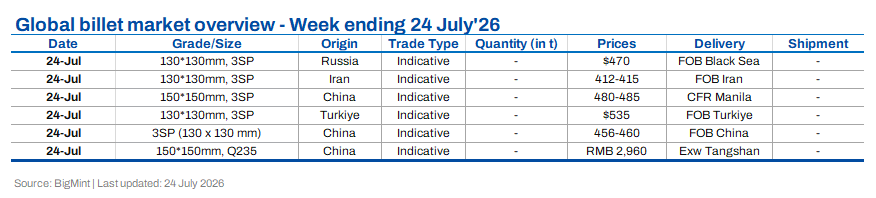
Asian billet export markets remained largely stable during the week ended 25 July, with trading activity subdued as seasonal demand weakness and wide bid-offer gaps kept Southeast Asian buyers on the sidelines. Chinese 3SP billet offers were maintained at $458-460/t FOB for September shipment, with workable levels at $452-455/t FOB, while Indonesian mills kept September offers unchanged at $465/t FOB against bids near $455/t FOB. No fresh deals were reported during the week.
In Southeast Asia, 5sp billet offers were stable at $482-486/t CFR, while buyers targeted $470-478/t CFR. China-origin billet to Taiwan fell by $10/t w-o-w to $470-480/t CFR, but buying remained weak. Indonesian billet was offered at $520-525/t CFR Turkiye, while Chinese material was heard at $510-520/t CFR, with Turkish buyers seeking levels below $500/t CFR.
Domestic billet prices fell RMB 30/t ($4/t) w-o-w to RMB 2,960/t ($437/t), while SHFE rebar futures eased to RMB 3,076/t ($454/t) amid weak seasonal demand and softer iron ore and coke prices. Despite lower steelmaking costs, Chinese billet export offers remained stable at $460/t FOB as mills maintained offer levels despite cautious overseas demand.
China further strengthened its position in the GCC billet market during H1CY’26, with exports to the region more than doubling, driven by robust demand from the UAE and Saudi Arabia. Competitive Chinese prices and logistics disruptions in the Strait of Hormuz supported shipments, while Oman emerged as a key regional redistribution hub.
Despite stable export offers, market participants expect billet trading to remain cautious amid seasonal demand weakness, shipping disruptions, and ongoing geopolitical uncertainties.
CIS billet market:
The CIS billet export market remained subdued during the week ended 25 July as weak finished steel demand, lower scrap prices, and cautious buyer sentiment continued to restrain trading activity. Market participants reported limited negotiations, with buyers seeking additional discounts while producers largely maintained existing offer levels.
Russian billet offers to Turkiye were heard at $490-500/t CFR, equivalent to around $465-470/t FOB Black Sea, while workable levels were reported at $490/t CFR (around $460-465/t FOB).
BigMint’s FOB Black Sea billet assessment increased by $5/t w-o-w to $470/t FOB, supported by firmer offer levels despite subdued market activity.
Meanwhile, Ukraine’s Kamet Steel is expected to reduce July billet exports by around 70-75% m-o-m due to scheduled blast furnace maintenance. Market participants said the temporary decline in export availability could lend some support to regional billet prices, although overall sentiment remains weak amid sluggish downstream demand.
GCC billet market:
The Middle East billet market remained mixed during the week ended 25 July as supply constraints in Iran, expanding Chinese billet penetration in the UAE, and new steelmaking investments in Saudi Arabia influenced regional sentiment. While buying activity remained cautious amid seasonal demand weakness, structural developments continued to support the region’s long-term billet outlook.
In the UAE, China further strengthened its position after HBIS Group’s Tangshan branch received an ECAS certification, expanding the pool of approved billet suppliers. Chinese billet exports to the UAE surged around 400% y-o-y in H1CY’26, supported by stronger demand from re-rollers and the increasing competitiveness of Chinese semis.
Meanwhile, Iranian billet export offers increased to $410-415/t FOB, supported by electricity shortages and tighter supply. Exporters increasingly shifted shipments through western borders and Turkiye’s Iskenderun port to reduce risks associated with southern ports, with billet offers from Iskenderun heard around $460/t DAP. Demand from Iraq, Syria, and Jordan remained subdued due to seasonal weakness.
In Saudi Arabia, imported billet prices eased to $530-540/t CFR in late June, the first decline since November 2025, following lower-priced Asian bookings. Meanwhile, Al Yamamah Steel confirmed plans to commission a new billet meltshop by mid-2028, enabling billet production using scrap and DRI to reduce reliance on imports and strengthen long-term domestic billet supply.