

India: Alang ship-breaking scrap prices remain stable d-o-d as need-based buying offsets firmer steel market

-
- Scrap supply remains adequate, limiting price rise
-
- Mandi scrap, billet prices strengthen on improved trading
Ship-breaking melting scrap prices in Alang, Gujarat, remained stable d-o-d on 25 July 2026, with HMS (80:20) assessed at INR 33,500/t ($347/t) ex-yard. The market remained supported by balanced supply-demand fundamentals, with requirement-based buying by secondary steelmakers amid adequate availability of processed scrap weighing on prices. Although downstream steel prices strengthened across key markets, procurement activity remained measured, preventing any immediate movement in Alang scrap prices.

Gujarat market update:
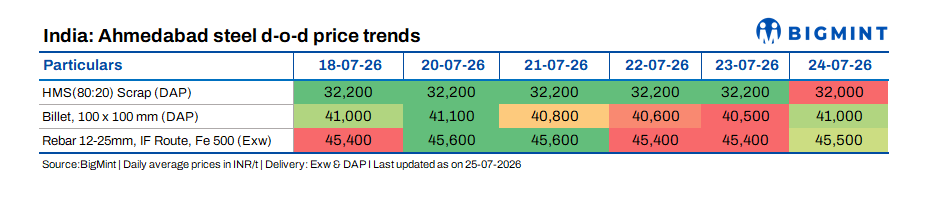
Downstream steel prices in Gujarat moved higher. Bhavnagar billet prices increased by INR 400/t d-o-d to INR 40,600/t DAP, supported by modest local trade, while Ahmedabad rebar prices edged up by INR 100/t to INR 45,500/t ex-works. The improvement in billet prices provided support to regional scrap sentiment, although buyers largely restricted purchases to immediate requirements, keeping overall market activity balanced.
Mandi market update:
Trading activity improved in Mandi Gobindgarh, supported by firmer buying interest. Billet prices rose by INR 150/t d-o-d to INR 42,250/t DAP, while HMS (80:20) melting scrap prices increased by INR 200/t to INR 34,800/t DAP. Rebar prices also moved up by INR 100/t to INR 46,900/t ex-works.
The improvement in semi-finished and finished steel prices encouraged mills to step up scrap procurement, leading to stronger trading activity in the local market. However, buying largely remained need-based, with participants continuing to monitor finished steel demand before committing to larger volumes.
Outlook:
Alang ship-breaking scrap prices are expected to remain supported over the coming week, backed by balanced processed scrap availability and firmer downstream steel prices. However, procurement is likely to remain largely requirement-based, which may limit any sharp upward movement unless finished steel demand improves further.