

Indonesia’s export controls fail to halt thermal coal price slide amid weak Asian demand

-
- FOB prices of 4,200 GAR slip to lowest level since Oct’23
-
- Indian, Chinese demand weakens on ample domestic supply
Indonesia’s ambitious attempt to strengthen its influence over international coal pricing is facing its first major test. Less than two months after Jakarta launched a centralised export mechanism aimed at curbing commodity undervaluation and improving state revenues, Indonesian thermal coal prices have continued to slide, with the benchmark 4,200 GAR grade falling to its lowest level since October 2023.

The weakness has little to do with Indonesian supply. Instead, it reflects deteriorating demand across Asia’s two largest importers — China and India. Chinese utilities remain well supplied following aggressive restocking earlier this year, while India’s monsoon has sharply reduced spot procurement requirements at a time when domestic coal production remains robust.
The episode illustrates a broader lesson for commodity markets: governments can influence supply discipline, but they cannot create demand. Unless Asian utilities return to the seaborne market in meaningful volumes during the second half of the third quarter, Indonesian low- and medium-calorific coal is likely to remain under pressure despite tighter production controls.
Indonesia’s pricing ambition meets market reality:
Indonesia occupies a unique position in the global thermal coal market. As the world’s largest exporter of thermal coal, its pricing decisions have a direct bearing on electricity generation costs across Asia, particularly for utilities dependent on low- and medium-calorific coal.
Recognising this strategic position, the Indonesian government introduced Danantara Sumber Daya Indonesia (DSI) in May 2026, a state-backed export mechanism intended to centralise commodity exports, improve pricing transparency, and reduce the long-standing problem of under-invoicing.
The objective was straightforward. By routing export contracts through a central platform, Jakarta hoped to strengthen pricing discipline, improve tax collection, and increase the bargaining power of Indonesian exporters. However, the market has delivered an uncomfortable verdict.
Instead of strengthening, benchmark Indonesian coal prices have continued to weaken, suggesting that demand fundamentals remain far more influential than administrative reforms.
Prices continue to drift lower:
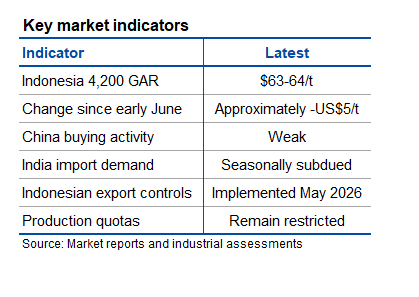
The clearest evidence of this disconnect can be seen in the performance of Indonesia’s flagship export grade. FOB Kalimantan 4,200 GAR has slipped to around $63-64/t in early July, the weakest level since late 2023.
Market indications show that sellers have steadily reduced expectations over the past month.
Between early June and early July 2026, Indonesian-origin 4,200 GAR thermal coal prices witnessed a notable correction amid weak buying interest and ample supply. Offers declined by around $4.5/t, falling from approximately $69/t to $64.5/t, while bids dropped by $5/t to around $62.50/t, reflecting increasingly cautious procurement by buyers.
Consequently, spot market assessments eased to $63-64/t, marking the lowest price level since October 2023, as sufficient domestic coal availability in key importing markets and subdued demand continued to weigh on international coal prices. Higher-calorific products have shown greater resilience, but even these grades have lost momentum as buyers increasingly postpone procurement decisions.
Rather than creating upward price momentum, DSI has entered the market at precisely the time when regional demand has begun to soften.
China has stepped back from the market:
The biggest driver behind Indonesia’s weakening prices is China.
Earlier this year, Chinese utilities aggressively replenished inventories amid concerns over Middle East tensions and tighter LNG markets. That buying programme has largely ended.
Today, utilities and traders are carrying comfortable inventory levels, reducing the need for additional imports. At the same time, several temporary factors have further weakened demand.
Persistent rainfall across southern China has moderated electricity consumption, while the arrival of typhoon activity has dampened cooling demand and disrupted parts of the domestic logistics chain.
The result has been a sharp slowdown in seaborne purchasing activity.
Instead of competing aggressively for Indonesian cargoes, Chinese buyers have largely withdrawn from the spot market, leaving exporters with fewer pricing options.
India’s monsoon has added to the pressure:
India, traditionally the second pillar of Indonesian demand, has offered little relief.
The southwest monsoon has significantly reduced electricity demand across much of the country, easing immediate coal burn requirements.
More importantly, India’s domestic coal market remains well supplied.
Coal India has maintained strong production and dispatch levels, while power plant inventories, although lower than last year, remain broadly adequate for seasonal demand. Utilities, therefore, have little incentive to chase imported cargoes, particularly when domestic coal remains significantly cheaper for many consumers.
This has translated into noticeably weaker buying interest for Indonesian coal across the lower- and medium-calorific segments.
The combination of a well-stocked China and a monsoon-affected India has effectively removed the two largest demand centres for Indonesian exports.
Domestic supply competition is intensifying:
The weakness in import demand has been compounded by increasing competition from domestic coal in both China and India.
Chinese buyers continue to favour local coal, supported by stable domestic production and ample mine inventories.
Similarly, Indian consumers have increasingly relied on domestic supply as Coal India continues to improve availability through commercial auctions and higher dispatches. For imported Indonesian coal, this creates a difficult pricing environment.
Even though Indonesian production quotas remain constrained and exporters are reluctant to cut prices aggressively, buyers see little urgency to secure imported cargoes when competitively priced domestic alternatives remain readily available.
This imbalance explains why offer prices have gradually moved lower despite relatively disciplined export supply.
Export controls alone cannot support prices:
The recent market behaviour highlights an important principle that extends beyond Indonesia.
Commodity pricing ultimately reflects the balance between supply and demand. Administrative reforms may improve market transparency and strengthen fiscal revenues, but they cannot offset weak consumption.
Indeed, some Indonesian producers have expressed concern that DSI could increase administrative costs at a time when profitability is already under pressure from lower production quotas and Domestic Market Obligation (DMO) requirements.
Rather than supporting prices, additional compliance costs could further compress producer margins if export demand remains subdued.
This suggests that Indonesia’s policy framework should be viewed primarily as a governance reform rather than a short-term price support mechanism.
Implications for the seaborne coal market:
Indonesia’s price weakness has implications well beyond its own export industry.
Lower Indonesian prices continue to exert downward pressure across the broader low-calorific coal complex, influencing Australian 5,500 NAR material, South African lower-CV grades and delivered prices into India, China and Southeast Asia.
At the same time, the divergence between Pacific and Atlantic markets is becoming increasingly pronounced.
While Indonesian coal struggles under weak Asian demand, DES ARA prices continue to draw support from tightening European gas fundamentals, recurring heatwaves, and reduced French nuclear generation. The result is an increasingly bifurcated global market, where Atlantic coal is being driven by energy security concerns, while Pacific coal remains hostage to subdued utility buying.
Outlook:
The near-term outlook for Indonesian thermal coal remains challenging.
Seasonal weakness in India is likely to persist until the monsoon begins to retreat, while Chinese buyers appear comfortable relying on existing inventories unless weather conditions materially increase electricity demand.
On the supply side, Indonesia’s tighter production quotas and the DSI export framework should help prevent an uncontrolled collapse in prices, but they are unlikely to reverse the current downtrend without a corresponding improvement in demand.
The key catalyst to watch will be the return of Asian utility buying during late July and August. A sustained increase in cooling demand in China or renewed procurement from India after the monsoon could quickly tighten the market and stabilise prices.
Until then, Indonesia’s experience serves as a reminder that, in commodity markets, pricing power ultimately rests with consumers rather than producers. Export controls can improve market discipline, but they cannot substitute for demand.


