
India: JSW Steel’s May’26 crude steel output rises 15% y-o-y after Dolvi, JVML ramp-up

-
- BF-3 restart to support supply in Q1FY’27
-
- Higher output to improve domestic steel supply
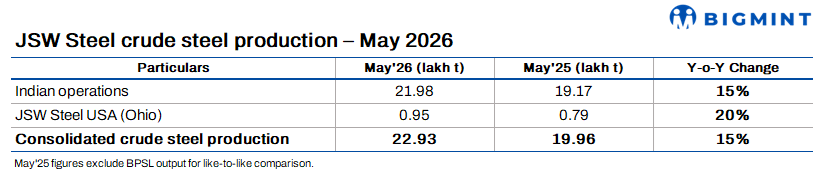
JSW Steel reported consolidated crude steel production of 2.293 million tonnes (mnt) in May 2026, registering a 15% year-on-year (y-o-y) increase from 1.996 mnt in the corresponding month last year. The increase was primarily driven by the return of full-scale operations at its Dolvi works and the full ramp-up of JSW Vijayanagar Metallics Ltd. (JVML), partially offsetting production loss from the ongoing shutdown of Blast Furnace-3 (BF-3) at Vijayanagar.

Production from the company’s Indian operations rose to 2.198 mnt, up 15% y-o-y from 1.917 mnt in May 2025. Meanwhile, JSW Steel USA’s Ohio facility produced 95,000 t, compared with 79,000 t a year earlier, reflecting a 20% increase.
For comparison purposes, the company adjusted May’25 production figures to exclude output from the erstwhile Bhushan Power & Steel Ltd. (BPSL), whose steel business was transferred to JSW-JFE Steel Ltd. in March 2026.
Operational efficiency offsets temporary capacity loss:
JSW Steel attributed the production growth to the restoration of normal operations at the Dolvi plant after one blast furnace underwent planned maintenance during May last year. Additionally, JVML operated at full capacity during the month, supporting overall production despite BF-3 at Vijayanagar remaining under shutdown for capacity enhancement.
The company expects BF-3 to restart during the second fortnight of June 2026. Excluding the idled furnace, capacity utilisation across Indian operations stood at around 98%, while overall utilisation, including BF-3, was 87%, highlighting strong operating performance across the remaining production assets.
Higher output likely to improve domestic steel availability:
The recovery in production comes at a time when Indian integrated steelmakers continue to operate at high utilisation levels despite softer domestic demand. The additional volumes from JSW are expected to improve the availability of flat and long steel products in the domestic market during June and July, particularly after BF-3 resumes operations.
However, demand-side fundamentals remain relatively weak. Construction activity has begun to slow with the onset of monsoon, while distributors across several regions continue to follow need-based procurement amid limited price visibility. Consequently, the higher production is unlikely to translate into immediate price gains unless supported by stronger infrastructure spending and seasonal demand recovery after the monsoon.
Capacity expansion strengthens JSW’s long-term growth strategy:
The restart of BF-3 marks an important milestone in JSW Steel’s ongoing brownfield expansion programme at Vijayanagar, the company’s flagship manufacturing complex. The upgraded furnace is expected to improve hot metal availability, increase crude steel production and support the company’s transition towards its long-term capacity target of 54.8 mnt/year over the next four years.
With integrated operations, captive raw material linkages and improving operational efficiencies, JSW Steel remains well positioned to maintain high capacity utilisation despite temporary maintenance shutdowns. The company’s production performance also reflects relatively stable raw material availability, particularly iron ore and coking coal, compared with the supply disruptions witnessed over the past two years.
Outlook:
The expected restart of Blast Furnace-3 at Vijayanagar in the second half of June is likely to support higher crude steel production and improve product availability during Q1 FY’27. As capacity utilisation returns to normal, JSW Steel is expected to strengthen domestic dispatches while maintaining operational efficiency. However, with steel demand typically moderating during the monsoon season, the market’s ability to absorb additional volumes will remain a key factor. A sustained recovery in infrastructure activity, construction demand and export opportunities will be crucial to support higher production without exerting further pressure on domestic steel prices.