
MYSTEEL: Simandou ore’s debut might make a splash, but prices will barely ripple
-
- Low-grade fines could gain indirect market support
-
- Traders optimistic on future mainstream market acceptance
Mysteel Global: The long-anticipated Simandou iron ore project in Guinea, West Africa, is finally living up to its promise, with shipment volumes climbing faster than many had expected. While chemical composition drawbacks suggest Simandou ores are unlikely to fully replace Brazil’s Carajs fines (IOCJ) in production anytime soon, growing supply of the ore is set to reshape the price dynamics of the global iron ore market, according to a detailed analysis from Mysteel.

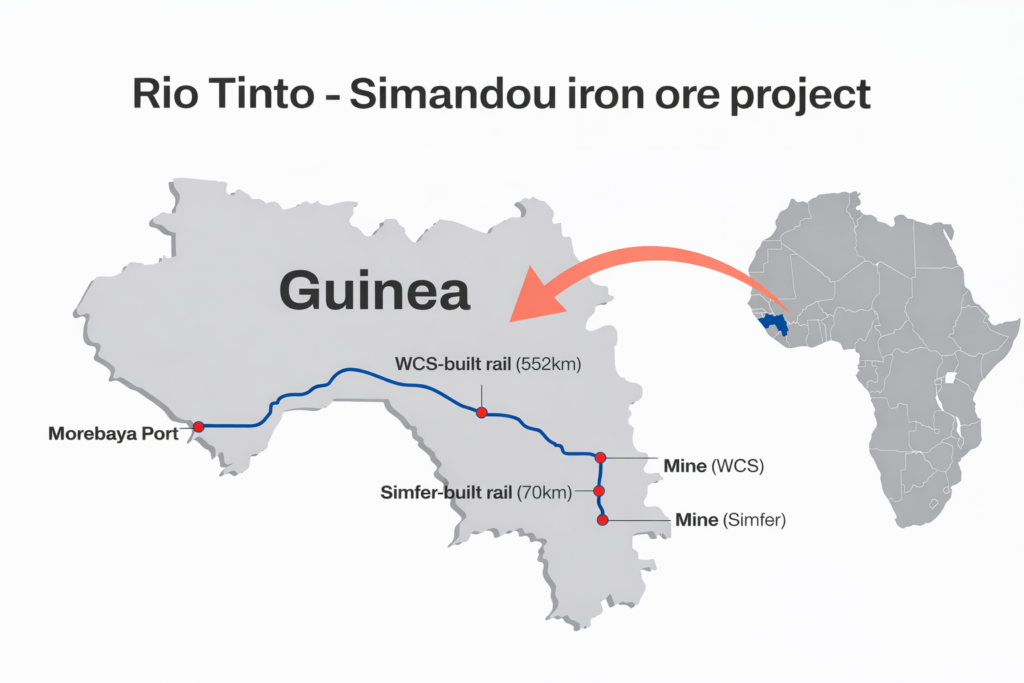
The first vessel carrying Simandou ores set sail from Guinea’s Morebahia Port in November 2025 bound for Majishan Port in East China’s Zhejiang and since then, the operation has moved from symbolic to substantial.
By mid-May this year, cumulative shipments from Simandou had reached approximately 6 million tonnes, with weekly volumes hitting a record 974,000 tonnes in the second week of May, Mysteel’s tracking shows. Meanwhile, also as of May’s second week, China had received about 3.2 million tonnes of Simandou ores, accounting for over half of the total shipments.
Yet for Chinese steel mills, the ore is no direct replacement for Brazil’s high-grade IOCJ, the analysis points out, despite its lower silica content – an advantage that leads to lower slag volumes and boosts smelting efficiency.
While both ores boast similar iron grades of around 65-66%, Simandou carries significantly higher alumina content – roughly 2.7% compared to IOCJ’s 1.4%. High alumina thickens slag, disrupting furnace operations and reducing efficiency. Therefore, to use Simandou ores, mills would need to adjust their burden recipes to accommodate it, the Mysteel report notes.
In addition, Simandou ores contain some lump ore, requiring screening before use – an extra cost step compared to IOCJ’s fines.
Not surprisingly, market feedback collected by Mysteel shows a clear split in sentiment regarding use of Simandou ores. Northern and eastern Chinese mills are cautiously optimistic, planning trial batches to test the feedstock, though some insist on stable supply and satisfying themselves there’s a price advantage before committing to long-term use.
For mills in southern China on the other hand, they see using high-alumina Simandou ores as costly and technically demanding, as their slag systems are optimized for low-alumina feeds. Some prefer Canadian or Chilean high-grade fines, citing lower processing costs.
Traders, however, are more enthusiastic, with several already purchasing Simandou material, betting on it becoming a mainstream product. They argue that higher alumina can be managed through blending, while low silica offers a genuine advantage.
In practice, transaction activity remains limited. Only a few steel groups – including Baowu, Rizhao Steel, and Weiqiao – have concluded deals, either via long-term contracts or spot purchases. Most mills are still in the trial or hesitation phase, buying small volumes for technical validation. Simandou ores are slowly becoming more available in China’s spot market, but some time will be needed for them to replace other ores in large scale.
Looking ahead, Simandou’s Blocks 1 and 2 are ramping up, while Blocks 3 and 4 are expected to contribute to output from the second half of this year. Meanwhile, the logistics chain – the 650-kilometer Dapilon-Santou railway and the new ore terminal at Morebahia port – is now in place, with the design capacity of 40 million tonnes/year supporting the ramping up of shipments.
Given that Simandou cargos will gather pace after the July-September rainy season in West Africa ends, Mysteel forecasts full-year shipments could exceed 20 million tonnes this year. While that figure appears significant, it remains a fraction of global seaborne supply: global iron ore production totalled about 2.61 billion tonnes in 2025, according to Mysteel estimates.
This means that despite more Simandou ore flowing into the global market, the overall benchmark iron ore price is likely to drift only moderately lower, not collapse. The real pressure will be on high-grade premiums, especially for IOCJ, as Simandou offers a competing high-Fe, low-silica alternative. If mills (including those in China) update their technology to better accommodate Simandou ores, those premiums could narrow further, the report observes.
In this scenario, cheaper high-grade supply may prompt mills to shift from medium-grade ores toward a blend of high-grade and low-grade materials. This could provide indirect support to low-grade fines, though the upside remains limited.
In short, Simandou’s arrival will not shock prices but reshape premiums across quality grades, putting pressure on high-grade ore while providing some support for low-grade ones, the analysis concludes.
Note: This article has been written in accordance with a content exchange agreement between Mysteel Global and BigMint.