

Global steel prices show mixed trends in Jan’26 even as coking coal surges

-
- Wet weather in Australia pushes up Indian imported coking coal prices
-
- Chinese iron ore prices remain stable on restocking before Lunar New Year
-
- Chinese HRC prices inch up as new export licensing system kicks in
Morning Brief: Global steel and raw material prices showed mixed trends in January 2026, as per their monthly averages assessed by BigMint.

Benchmark Chinese iron ore fines prices, Indian coking coal prices, and Turkish scrap prices either remained stable or increased sharply, keeping steel raw material costs elevated. However, price trends for steel exports varied, with buyers in key regions remaining disengaged or showing price resistance.
Highlights of price movements in Jan26:
Chinese iron ore: Chinese imported iron ore prices (Fe 61%) remained largely stable m-o-m in January at $106/t CFR, supported by restocking activity ahead of the Lunar New Year in February and a rebound in crude steel production from Decembers lows. Trading activity was mainly concentrated in medium-grade fines due to mills cost pressures. Elevated port stocks weighed on buying appetite, while positive expectations regarding macroeconomic policies intermittently offered support.
Indian imported coking coal: BigMints coking coal index, CFR India, surged 9% m-o-m in January as Australian premium hard coking coal (PHCC) prices, FOB Hay Point, shot up to their highest level since July 2024, driven by tight supply.
In early January, severe rainfall and floods, as well as Cyclone Koji, affected mining and logistics operations in Queensland. Consequently, several leading coking coal suppliers declared “force majeure” on their shipments, implying an inability to fulfil deliveries due to extraordinary and unforeseeable circumstances.
Turkish melting scrap: Imported US-origin HMS (80:20) prices in Turkiye edged higher by 2% m-o-m, fuelled by firm collection costs, a stronger euro (1 EUR = averaging 50.7 TRY in January versus 50 TRY in December), and rising freights. Supply from both the EU and the US remained limited amid collection constraints during winter.
Additionally, domestic scrap demand in the US remained robust, as mills capacity utilisation rates remained elevated, which reduced the export material availability. However, weak rebar demand and tight mill margins limited price gains in Turkish imported scrap.
Russian billets: Tightening export supply drove up Russian billet offers by a marginal 0.3% m-o-m, with some mills having exhausted their export quotas. However, weak rebar demand in Turkiye and lean margins weighed on buying interest for billets, while a stronger rouble (1 US dollar = averaging 78.2 RUB in January against 78.6 in December) pushed buyers to reduce bids. Billet price reductions from Kardemir also pressured demand for Russian billets.
Turkish rebar: Weak construction demand during the winter and need-based trading activity pressured Turkish rebar export prices, which led to a slight 0.7% dip. While high scrap costs pushed sellers to keep offers firm, they ultimately had to accept lower bids. This also contributed to the divergence between rising scrap costs and falling rebar prices.
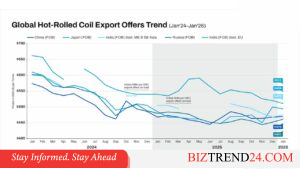
Chinese HRCs: Export offers of Chinese HRCs inched up by a negligible 0.3% m-o-m in January, as the new export licensing system took effect. Exporters began to price in taxes to comply with the new norms, leading to tightening availability of non-value added tax (VAT) cargoes. Firm raw material costs supported HRC prices, but cooling demand from a weakening price advantage forced exporters to reduce their offers. Additionally, prices received a boost from interest rate cuts and liquidity improvement measures, which fostered positive market sentiment. However, limited demand from key markets such as the Middle East and tightening export opportunities driven by trade barriers prevented sharp price hikes.
Indian HRCs: Meanwhile, Indian HRC export offers showed mixed trends. BigMints HRC index tracking EU-bound cargoes slid 2% m-o-m, while that for the Middle East and Southeast Asia increased by a minor 1%.
Offers to the EU declined as trade slowed sharply following the full implementation of the Carbon Border Adjustment Mechanism (CBAM) from 1 January. Earlier in the month, a source informed BigMint, “Indian mills have fully exhausted their allocated quota for Q1CY26. With the CBAM now in force, buyers are increasingly relying on mills declared emissions values, while the verification process has been initiated by most mills”.
In the Middle East, however, Indian offers increased following the conclusion of some deals. The market remained active for most of the month, though trading activity was moderately weak.
Outlook:
Current trends in global steel prices are expected to persist in February. HRC prices may strengthen in February on limited availability, as Chinese exporters will be absent from the market during the Lunar New Year holidays and are unlikely to price cargoes excessively low amid the new taxation norms. The absence of competitive offers could support Indian offers to the Middle East, though HRC offers to the EU may weaken due to CBAM cost pressures.
Iron ore prices are likely to find support from restocking following the Lunar New Year, while wet weather in Australia may keep prices high. However, if coking coal demand softens, especially with Indian mills turning to imported met coke from Indonesia, prices may decline.
Scrap prices may remain at around current levels even as tight supply continues in major exporting regions, as downward pressure may persist from weak rebar prices.