

India’s manganese ore imports rise 4% in CY’25 – BigMint report

-
- Ore imports increase to 6.46 mnt
-
- South Africa top exporter at 3.93 mnt
-
- Higher steel production, alloys exports boost imports
Morning Brief: India’s imports of manganese ore increased by 4% y-o-y to 6.46 million tonnes (mnt) in CY25 against 6.21 mnt in CY24, as per latest provisional data available with BigMint. Rising steel production in the country and manganese alloys production and exports boosted higher manganese ore imports.

Country-wise imports:
South Africa remained the top exporter to India, with total shipments increasing by 3% y-o-y to 3.93 mnt. While Gabonese volume slid by 1% y-o-y to over 2 mnt, imports from Australia rose by 74% to 0.11 mnt.
Weather disruptions affected supplies from South Africa and Gabon.
Grade-wise imports:
Mid-grade Mn 35-46% ore imports recorded the steepest rise, increasing by 27% y-o-y to 5.36 mnt. However, imports of Mn 25-25% decreased sharply by over 60% y-o-y to 0.58 mnt.
On the other hand, imports of high-grade Mn 46% and above ore decreased slightly by 2% to around 0.46 mnt.
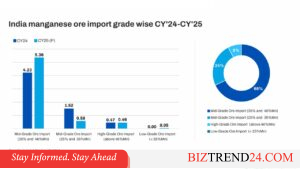
Manganese ore import scenario in CY’25:
Crude steel output surges: India’s crude steel production increased by over 10% y-o-y to around 165 mnt in CY’25 against 149 mnt in CY’24. This boosted manganese alloys production. Therefore, amid domestic dearth, imports of high-grade manganese ore remained supported.
Higher alloys exports despite trade disruptions: Exports of silico and ferro manganese by Indian producers in CY’25 increased by 22% y-o-y to over 2.3 mnt. Ferro manganese exports rose by 24% despite the fact that slower shipping movement in the MENA region due to heightened geopolitical risks (e.g., Red Sea and Gulf crises) impacted Indian manganese alloys export prospects. Importers in these regions deferred or re-negotiated contracts due to volatile exchange rates.
With manganese alloys exports accounting for around 50% of domestic production, higher exports naturally triggered domestic production, manganese ore consumption and imports. Higher raw materials prices, along with steep electricity costs, impacted manganese alloys production in different regions of the country. Nevertheless, exports provided support.
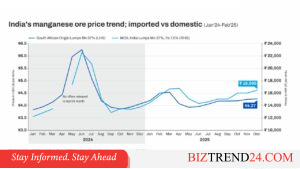
Wet season impacts supplies: The impact of weather disruptions on manganese ore supply was palpable. The wet season typically spans November to March in both South Africa and Gabon, coinciding with peak rainfall across major mining and logistics corridors. Heavy rainfall restricted rail and road movements of manganese ore from mines to ports, leading to slower evacuations and shipment delays.
Major miners reported loss in production. South32, for instance, reported a sequential decline in manganese ore production for the quarter ending December 2025 (Q2 FY2026), with total output falling to 1.312 million wet metric tonnes (mnt) due to the earlier impact of cyclones and weather disruptions in Australia and South Africa.
India, China demand tightens supplies: Simultaneous bulk buying by Indian majors and inventory restocking by China have significantly tightened the imported manganese ore market, reinforcing bullish price sentiment amid rising geopolitical uncertainty. The steady depreciation of the INR has led to cost inflation for Indian manganese smelters and alloy producers.
Domestic manganese ore production rises: India’s manganese ore production rose by 7% y-o-y to 3.83 mnt in CY’25. State-run MOIL recorded an impressive performance, recording total production of over 1.4 mnt in 9MFY26, an increase of 7% y-o-y.
Outlook:
Imported manganese ore volumes into India may moderate slightly as tightening global supply conditions and elevated geopolitical risks limit fresh shipment availability from overseas. With a significant portion of nearterm requirements already covered through frontloaded bulk bookings, incremental imports could ease marginally as buyers turn selective and focus on inventory management.