

BigMint’s India steel index rises w-o-w as primary mills hike rebar prices and coking coal costs surge

-
- rade-level HRC, CRC prices rise w-o-w after mills hike prices
-
- Leading primary mills increase BF rebar prices by up to INR 1,250/t
-
- Q4 momentum, rising raw materials prices to support steel prices
Morning Brief: BigMint’s flagship India steel composite index, a barometer of the domestic steel market, recorded an increase of 1.5% w-o-w in the week ending 23 January 2026. While the long steel index rose by 1.3%, the flats index climbed 1.9% w-o-w as steel prices rebounded after hitting five-year lows in November and December.

The sharp recovery in steel prices in the beginning of CY’26 indicates a keen willingness on the part of the leading mills to raise prices quickly in order to account for surging raw materials prices. The safeguard duty emerged as a key turning point in Q4CY25, curbing low-priced imports and tightening domestic availability.
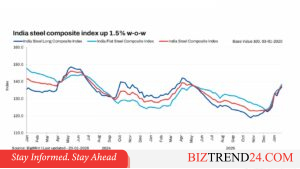
Iron ore prices (especially lumps) in Odisha and other key states have remained relatively stable in CY’25, while premium hard coking coal, after touching near-term lows around $205/t CFR in October, strengthened from November and rose further into December and January. This compressed mill margins in Q4, limiting price downside and setting the stage for a sharp revision once mills regained pricing leverage.
Coking coal surges:
BigMint’s coking coal (PHCC) index surged from $215/t CFR India in January 2025 to $247/t CFR India last week, marking a steep escalation after a largely rangebound first half in CY’25. Weather-related disruptions in Australia, owing to heavy rainfall from Cyclone Koji, have prompted a few miners to go for force majeure, which have resulted in limited offers in the market in early-January. The Indian rupee’s depreciation against the US dollar further boosted the landed costs of coking coal in India.
Highlights of price movements:
HRC trade prices edge up: Trade-level prices of hot-rolled coils (HRC) increased w-o-w following the announcement of price hikes by mills, with HRC prices assessed in the range of INR 50,000-52,900/t ($550-581/t). In line with this trend, cold-rolled coil (CRC) prices also edged up w-o-w, with prices assessed at INR 54,500-60,500/t ($599-665/t).
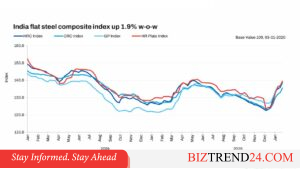
In the previous week, festive holidays had kept demand and trading subdued. However, mill-led price hikes sparked a rebound in trade-level prices as activity resumed post-festivities. While demand remained moderate, fewer working days from bank holidays on Saturday and Monday pushed participants to liquidate swiftly for payment management.
BigMint’s India HRC (S275) export index for the European Union (EU) remained unchanged w-o-w at $505/t FOB main port while the HRC (SAE 1006) export index for the Middle East and South East Asia rose by $5/t w-o-w to $480/t FOB main port from $475/t following a recently concluded deal.
Mills hike primary rebar prices: The Indian Tier-I mills increased rebar prices by up to INR 1,250/t ($14/t), sources informed BigMint. Post-revision, list prices stood at INR 54,500-55,500/t ($593-604/t) on landed basis. Trade-level blast furnace (BF) rebar prices (distributor to dealer) rose w-o-w across major Indian markets. Strong material lifting was observed in the trade channel this week. Robust demand from the infrastructure and construction segments led to a material shortage at mills, supporting prices.
BigMint’s benchmark assessment (bi-weekly) for Rebar (IS 1786 Fe 550D, 1232 mm, BF route, ex-Mumbai) inched up by INR 1,500/t w-o-w to INR 55,300/t on 23 January compared with INR 53,800/t in the previous assessment on 16 January. These prices are ex-Mumbai for the distributor-to-dealer segment and exclude 18% GST.
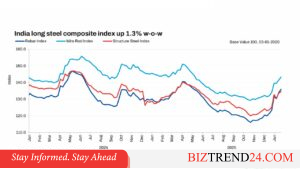
IF-route rebar trade prices witnessed an upward trend mainly due to sellers holding future booking orders. However, market activity remained subdued at elevated prices. Fresh bookings were limited despite higher offers, as many buyers had already procured material in the previous week. Weakness in semi-finished steel prices further weighed on sentiment, prompting buyers to adopt a wait-and-watch approach.
Outlook:
A lot of factors have combined to provide adequate support to steel prices. Imports have moderated after the safeguard duty, elevated coking coal costs, disciplined supply management, and stronger pricing resolve from mills are expected to keep prices strong in February. Improved order visibility and front-loaded buying activity, with consumers accelerating procurement to complete projects before the end of FY26, may also lend near-term support to prices.