

India’s coking coal imports increase by 10% y-o-y in CY’25 – BigMint report

-
- Australia retains dominant share in PHCC market
-
- Total met coal imports reach around 83 mnt
-
- Average global coking coal prices may remain higher in CY’26
Morning Brief: India’s imports of metallurgical coal, a key ingredient in blast furnace-based steel production, increased 9.4% y-o-y in CY’25 to over 83.1 million tonnes (mnt) from round 76 mnt in CY’24, as per latest data with BigMint.

Imports increased due to higher steel production in India, the only major economy in the world to witness a surge in steel production in CY’25 amid overall global decline. Imports have a share of roughly 95% of India’s met coal demand.
Notably, imports of coking coal in the year gone by were assessed at around 62.6 mnt compared with over 57 mnt in CY’24, an increase of 9.8% y-o-y. The rest was accounted for by pulverised coal injection (PCI) coals, with total import volumes at over 21 mnt in CY’25.
Country-wise imports:
In terms of PCI imports, Russia held the dominant share of over 14 mnt of exports to India in CY’25 out of a total of 21 mnt, with Australia accounting for the rest. In the coking coal segment, however, Australia topped the list of suppliers, as in other years, with total shipments at around 34 mnt, followed by Russia at 9.7 mnt and the US at 9.3 mnt.
Incidentally, while Indonesia recorded a decline in shipments, Russian exports to India increased sharply by over 37% y-o-y. Australian exports to India, moreover, increased by 9% y-o-y on overall volume growth, while its share in Indias import basket declined marginally on-year.
Port-wise arrivals:
In the coking coal segment, the eastern Indian ports topped the list in terms of arrivals, with Paradip at the top (over 12 mnt) followed by Dhamra (8.2 mnt), and Gangavaram (6.4 mnt). Y-o-y, Gangavaram recorded the steepest spike in arrivals followed by Mormugao and Paradip.
Highlights of met coal import market in CY’25:
Higher steel output boosts imports: BigMint data show that the country’s crude steel production increased by 10% y-o-y compared to 2024 to reach 164 mnt in 2025 from 149 mnt in the previous year. Total increase in volume terms was around 15 mnt. Growth was seen in the BF-BOF as well as the EAF-IF routes of production. However, Ministry of Steel data show that in April-December of the current fiscal hot metal production registered a growth of 6.1% to reach over 71 mnt, while crude steel production grew at 10.8%.
Therefore, the roughly 10-11% growth in crude steel production was the primary driver behind the 10% growth in India’s met coal imports.
Australia retains share in PHCC segment: While Australia’s share in India’s coking coal imports decreased marginally by 0.6% y-o-y, its share is still way ahead of others at around 55%, while the second-largest exporter Russia’s share trails at just over 15%. In the premium coking coal segment, Australia still retains its hold on Indian buyers, while hard coking coal from the US and Canada are making gradual inroads.
Accounting for the fact that Australian PCI exports are not significant, at around 3.5 mnt in CY’25, it can be seen that the country still maintains its hegemony in the premium seaborne steelmaking coal market.
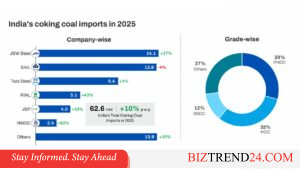
Demand for premium coal, PCI rising: Interestingly, in volume terms, the higher growth y-o-y has been recorded in the PHCC segment, around 4 mnt, followed by HCC (2.69 mnt), and PCI (2.22 mnt). Driving higher efficiency and reduction of the coke rate are priorities for BF-based steel producers and higher PCI usage is, of course, a cost-effective measure in the face of coking coal market volatility.
However, growth in mainstream HCC imports points to the efforts by the mills at blending premium grades with hard coal from different origins to test their impact on hot metal chemistry and production outcomes.
QR on met coke imports: The quantitative restrictions on imports of low-ash metallurgical coke imposed in two phases in 2025 also propelled coking coal imports to an extent, especially by mills reliant on bulk imports of coke for sustaining operations. Subsequently, an anti-dumping duty has been imposed on select countries for coke imports.
Domestic coking coal production drops: Domestic production of coking coal by CIL subsidiaries declined by 10% y-o-y in CY’25, with BCCL recording a drop of over 11%. Although due to insufficient washing capacity much of domestic coking coal is channeled to the power sector, key domestic producers dependent on their domestic operations and also sourcing from CIL were unable to rely on domestic sources for meeting a share of their requirements.
Outlook:
Average seaborne coking coal prices declined significantly in CY’25 compared to CY’24, and prices are reflecting an upward trend since November 2025. Seasonal disruptions in Australia are expected to support prices going forward, while Indian mills will be looking to ramp up shipments during the CNY holidays, with an eye on expected growth in crude steel production in February and March.
With WSA predicting growth in steel consumption in key countries in CY’26 compared to CY’25, average coking coal prices may remain higher in CY’26.