
India’s ferrous scrap market shifts toward domestic supply in CY’25, but imports remain structurally relevant

-
- Imports decline modestly in CY’25 as mills reduce 2nd half buying
-
- Domestic scrap availability, DRI usage increase materially
-
- Policy, corporate investments continue to reshape raw material mix
Morning Brief: India’s ferrous scrap imports declined modestly in calendar year 2025 (CY’25), falling to around 8.2 million tonnes (mnt) from 8.5 mnt in CY’24, as steelmakers reduced overseas purchases in the second half of the year. The decline was driven by improved domestic scrap availability, higher direct reduced iron (DRI) usage, and margin pressure, which encouraged mills to adopt more selective and need-based import strategies.
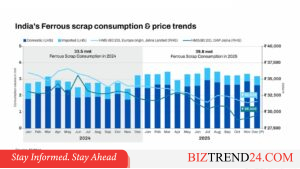
Similarly, the scrap-based crude steel production in India witnessed a sharp 23% rise from 31 mnt in 2024 to 38 mnt in 2025. Total ferrous scrap consumption remained broadly stable at 39-40 mnt, implying an average monthly consumption of around 3.3 mnt, broadly in line with CY’24.
The divergence between stable demand and lower imports was driven by changes in the raw material mix rather than weaker steel output.
Imports were front-loaded, with volumes peaking at 0.85 mnt in January and remaining elevated in March and April, when monthly arrivals exceeded 0.80 mnt. From mid-year, imports fell steadily, reaching a low of 0.46 mnt in November, as weaker construction activity, tighter profitability and better domestic metallic availability reduced appetite for seaborne scrap. A mild rebound in December reflected limited year-end restocking rather than a recovery in underlying demand.
Exports from US and UK suppliers remain under pressure with high seller prices and freight costs, so Indian buyers stay cautious–watching deals rather than jumping in at peak rates.
With growing global regulations creating uncertainty, Indian steelmakers prioritise supply chain strength by diversifying sources. They’re turning to reliable options like Oceania, South American and select Southeast Asian scrap instead of riskier European material, while big players lock in long-term contracts from stable regions for steady flows.
India’s steelmakers use smart strategies to cut costs without losing quality. Induction furnace mills–which make much of the country’s steel–often pick local DRI when prices make sense.
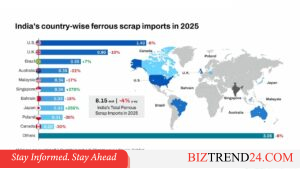
Even with falling containerised scrap imports (down by 8% y-o-y), bulk shipments jumped 40% y-o-y to 0.84 mnt in 2025 (from 0.6 mnt in 2024), thanks to reliable supply from Japan, Singapore, and Malaysia. South Indian ports took over 25% of total scrap imports with a major share in bulk arrivals all year–ideal for large mills needing big volumes. Handysize ships make this work: they are cheaper and easier to rent than containers, delivering scrap at low landed costs to power South India’s melting plants.
Scrap consumption steady, mix shifts:
Total ferrous scrap consumption remained broadly unchanged. Stable consumption indicates that electric arc furnace (EAF) and induction furnace (IF) operations were maintained through the year despite uneven downstream steel demand.
However, procurement patterns changed. Mills increasingly substituted imported scrap with domestic scrap and DRI, particularly during periods of international price volatility. As a result, imports played a more residual role in the second half of the year.
Domestic scrap availability improves:
Domestic scrap generation increased to an estimated 30.9 mnt in CY’25, providing a meaningful offset to reduced imports. Availability improved notably in the second half, peaking at around 2.9 mnt in November, and helped mills manage raw material costs during periods of margin compression.
While India’s scrap supply chain remains fragmented, higher availability reduced mills’ exposure to seaborne pricing and logistics risks, particularly during the monsoon and post-monsoon period.
DRI usage rises:
DRI consumption rose to around 58.1 mnt in CY’25, from 53.9 mnt in CY’24 (steel production by DRI remains around 46 mnt (+7% y-o-y) . Monthly usage remained consistently higher y-o-y, typically ranging between 4.7-5.1 mnt. The increase reflects continued capacity additions and mills’ preference for sponge iron as a cost-stable and domestically available metallic. DRI increasingly acted as a balancing input when scrap prices or availability became unfavourable, rather than as a short-term substitute.
Corporate investment targets scrap security:
Steelmakers accelerated investment in scrap processing and recycling during CY’25 to improve long-term supply security. AM/NS India commissioned a 120,000 t per annum (t/year) scrap processing unit at Khopoli, the first phase of a broader INR 350 crore plan aimed at lifting scrap usage beyond 10% by 2030. JSW-linked NSL Green Steel Recycling expanded shredded scrap supply through a high-capacity shredder at Khalapur, while Tata Steel outlined plans to scale recycling-based steel production to 10-15 mnt by the late 2030s.
These investments indicate a strategic shift toward integrating scrap into core metallic planning rather than treating it as a marginal input.
ELV-led scrap generation expands:
Automotive-led scrap generation strengthened during the year. Tata Motors commissioned its seventh Re.Wi.Re vehicle scrapping facility at Guwahati, lifting total end-of-life vehicle (ELV) processing capacity beyond 100,000 vehicles per year. JSW Steel announced plans for a 0.5 mnt/year recycling facility in Chennai, targeting ELVs and white goods, while Attero expanded recycling capacity as part of broader circular-economy initiatives.
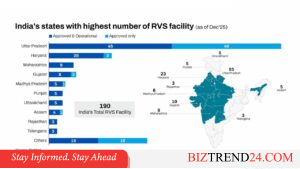
Despite these developments, ELV infrastructure remains geographically concentrated. Uttar Pradesh accounts for around 45% of registered scrapping facilities, with Haryana and Gujarat contributing a further 17%, leaving capacity across other states limited.
India’s RVSF network totals 190 facilities as of Dec 2025–125 operational post-approval, 65 approved but not yet functional.
Policy framework supports demand:
The rollout of ELV and extended producer responsibility (EPR) regulations from April 2025 introduced mandatory recycled steel usage, starting at 8% for 2025-30. While near-term impact on volumes is limited, the framework provides medium-term demand visibility for scrap and recycled steel. Discussions around goods and services tax (GST) rationalisation on ferrous scrap also gained traction during the year, though implementation remains uneven across states.
Outlook:
BigMint expects India’s ferrous scrap demand to remain structurally firm into CY’26, supported by steady steel production and rising recycling intensity. We see scrap consumption increasing toward 45-46 mnt, while domestic scrap generation is likely to improve to around 35 mnt, keeping imports close to 9 mnt.
Under Vision 2047 and the Vehicle Scrappage Programme, we expect scrap usage in steelmaking to rise toward 30% by FY’30. Even with higher recycling rates, we estimate total scrap consumption could reach 60-65 mnt against domestic availability of around 45 mnt, implying a 15-20 mnt structural gap that will need to be met through imports and alternative metallics.