

India: PELLEX remains stable even as sponge prices inch down

-
- Sponge iron and billet prices drop this week
-
- Moderate pellet trades finalised by Raipur sellers
Pellet prices in the Raipur region remained firm over the last couple of days on 6 January, supported by limited but steady trading activity at prevailing offer levels. Market participants indicated that while transactions were concluded in certain pockets, overall sentiment stayed cautious due to uncertainty in sponge iron prices.

Price movements, trades:
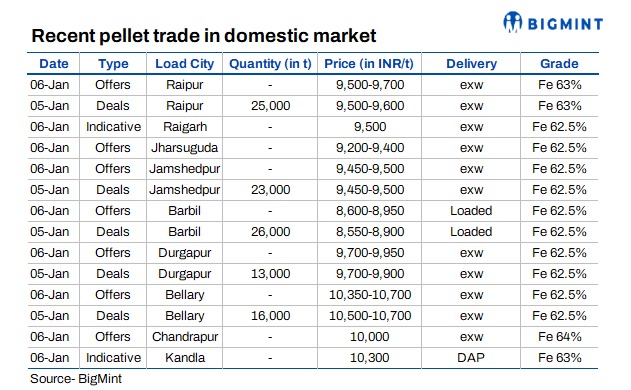
PELLEX, BigMint’s bi-weekly domestic pellet (Fe63%) index for Raipur, remained stable at INR 9,700/t ($108/t) DAP on Tuesday compared to the previous assessment on 2 January. Deals for around 25,000 t were concluded by Raipur-based sellers at INR 9,500-9,600/t ($105-106/t) exw.
Raipur-based pellet producers have increased offers for Fe 62.5-63% (+/-0.5) pellets by INR 100/t ($1/t) to INR 9,500-9,600/t ($105-106/t) exw.
Meanwhile, some Odisha-based sellers offered material at higher levels of INR 9,900-10,300/t ($110-114/t) DAP in Raipur.
Market scenario:
According to trade sources, the recent stability in pellet prices comes despite a softening trend in the downstream segment. Sponge iron and billet prices witnessed a decline in the last two days this week, following a sharp hike seen in the previous week. A buyer said, “After last week’s aggressive rise, the correction in sponge iron and billet prices was expected. This has made buyers more cautious in fresh pellet procurement.”
Buyers were seen booking pellets strictly on a need-basis, avoiding bulk purchases amid unclear price direction in the steel market. Major buyers, in particular, remained on the sidelines, closely monitoring the sustainability of steel prices.
A sponge producer informed, “At present, visibility is low. Steel prices moved up sharply last week, but the recent correction has raised doubts about how long the current levels can be sustained. The mills are waiting for clearer signals before committing to larger raw material volumes.”
On the supply side, pellet producers maintained their offers at existing levels. Suppliers noted that while offers remained unchanged, fresh inquiries were marginally lower compared to the previous week. A pellet maker said, “We are keeping our prices steady for now. However, inquiry levels have softened slightly as buyers reassess the downstream market.”
Market participants expect pellet prices in the Raipur region to remain stable in the near term, barring any sharp movement in sponge iron or billet prices. “For this week, the market is likely to see stable prices with some pockets of trade continuing, largely driven by immediate requirements,” a market participant observed.
Rationale:
-
- PELLEX has been derived using data points, i.e., trades, offers, and bids. To download the detailed methodology, click here.
-
- Two (2) deals were recorded in this publishing window, and all were taken for calculation. Thus, the T1 trade category was accorded 50% weightage.
-
- Sixteen (16) firm offers, bids, and indicative prices were heard. Twelve (12) were taken for price calculation and given a balance of 50% weightage.
Key market drivers:
-
- Sponge iron prices fall after last week’s rally: Sponge iron prices rose by INR 500/t ($5.5/t) w-o-w on 6 January to INR 24,400/t ($271/t) exw-Raipur. However, prices fell by INR 100/t ($1/t) d-o-d. Buyer participation remained minimal, as most buyers resisted prevailing offers. Trading activity was largely confined to small, need-based transactions, leaving the market nearly inactive for most of the session. Market sentiment stayed subdued, with participants widely anticipating further price corrections in the near term.
-
- Billet prices end rally: BigMint’s billet index increased by INR 1,100/t ($12/t) w-o-w to INR 40,900/t ($445/t) exw-Raipur on 6 January. Meanwhile, prices dropped by INR 400/t (4/t) d-o-d. Trading activity throughout the session was subdued, with most market participants staying on the sidelines. Expectations of further price correction weighed heavily on sentiment, resulting in limited spot transactions. Sellers attempted to stimulate demand by offering discounts; however, buyers continued to seek deeper corrections before committing to fresh bookings. As a result, trade volumes remained confined to need-based buying, reflecting an imbalance between buyer expectations and seller offers.
Outlook:
According to BigMint, the pellet market is expected to stay range-bound in the short term, with price direction closely linked to clarity in downstream steel price dynamics.