
How did global steel, raw material prices perform in CY’25?

-
- Lower crude steel output, weak steel demand weigh on prices
-
- Chinese HRC export offers fall 12%, Indian offers down by up to 15%
-
- Chinese steel output cuts, weak margins pressure iron ore fines benchmark
Morning Brief: Global steel and raw material prices fell y-o-y in CY’25, according to BigMint’s analysis of yearly averages. The price corrections, which were seen across the board, were driven by subdued steel consumption, largely tied to weak domestic demand in China, a rapid growth in Chinese steel exports, and mounting geopolitical tensions. Global crude steel production fell by 2% y-o-y to 1,662 million tonnes (mnt) in January-November 2025 in response to slowing steel demand.

To illustrate, the World Steel Association (WSA) in its October 2025 Short Range Outlook had forecast that global steel demand would remain stagnant y-o-y in CY’25. A 2% projected drop in Chinese steel demand would offset 9% growth in India, 5.5% in Africa and Central and South America, 1.3% in the EU and the UK, and 1.8% in the US.
Highlights of global steel, raw material prices in CY’25:
Chinese imported iron ore: Chinese Fe 62% iron ore fines prices slid by 10% y-o-y. While China’s iron ore procurement remained steady last year, evidenced by imports increasing by 1.4% y-o-y in January-November, a 4% drop in crude steel production exerted downward pressure on prices.
The property crisis continued, while even the manufacturing segment, which emerged as a major steel-consuming sector consequent to the explosion of the debt bubble in the real estate sector, witnessed slower investment growth and activity, eroding steel demand.
Poor steel margins during the second half, with less than 40% of mills able to earn profits, steel output restrictions to control air pollution and in alignment with the government’s anti-involution policy, and cautious sentiment due to trade war with the US also prevented iron ore price gains. Meanwhile, the steady build-up of portside inventories, climbing to over one-year high in early January 2026, dulled procurement urgency.
Indian imported coking coal: Indian imported coking coal prices decreased by 21% y-o-y, mirroring a 21% drop in Australian FOB prices. Primarily, the domestic steel market faced a prolonged demand slump during the year, driven by an extended monsoon, which dampened construction and infrastructure activity.
Additionally, finished steel production growth at 9% overtook consumption at 8%, leading to a supply glut in India. Consequently, steel prices plunged to five-year lows towards the year-end. The steep price drop and tight margins ultimately pushed Indian steelmakers to keep bids low.
Meanwhile, overproduction of coking coal in China in the first half of the year led to a decrease in Chinese imports, which lifted global supply and pressured prices. Notably, in January-September, Chinese met coal imports decreased by 6% y-o-y to approximately 83.6 (mnt), according to the General Administration of Customs.
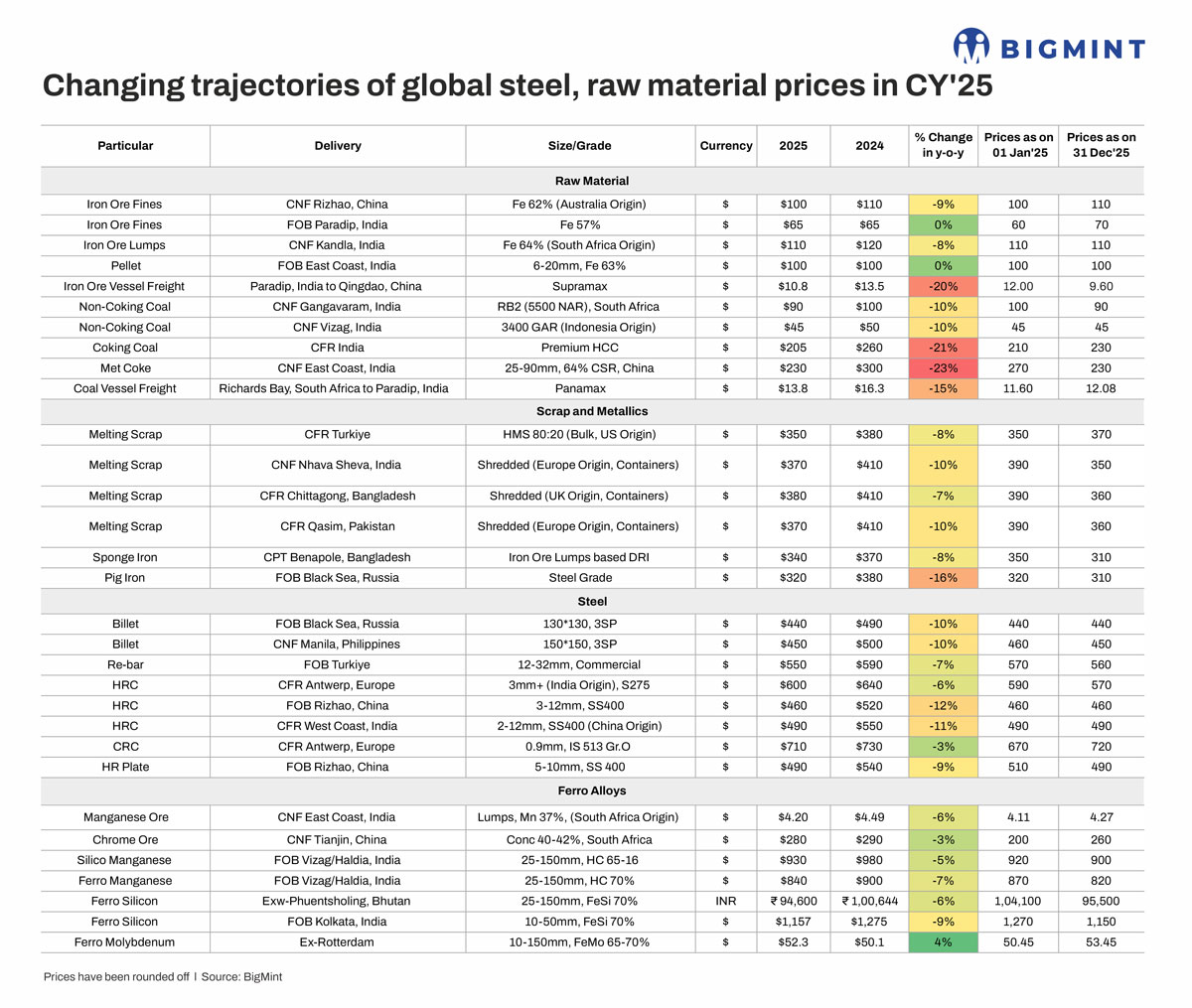
Turkish imported melting scrap: Turkish imported HMS 80:20 (US-origin, bulk) prices softened by 8%, with weak rebar demand and thin profit margins leading to cautious scrap purchases. Imports fell 7% y-o-y to around 14 mnt during January-September as a result of weak demand, even though crude steel production inched up by 0.5%.
The scrap-to-rebar conversion spread narrowed to $200/t in 2025 from $210/t in 2024, indicating that profitability remained under pressure. Additionally, the availability of competitively priced Chinese billets also prompted a shift away from scrap. To illustrate, Turkiye’s billet and bloom imports surged by 31% in January-October, with imports from China up 225%, according to a report by SteelOrbis.
Black Sea pig iron: Russian steel-grade pig iron prices, FOB Black Sea, fell a sharp 16% y-o-y. Turkish steelmakers accelerated procurement, with imports more than doubling to 1.4 mnt during January-October, as per a GMK Center report. However, the EU reduced its imports by 32% y-o-y to nearly 700,000 t.
Notably, Russian steelmakers struggled to secure bookings due to sanctions on Russian products. To illustrate, the US, which had earlier been a key market for Russian pig iron suppliers, had introduced a 70% tariff on the same in 2023, while the EU had imposed phased quota restrictions, with a complete ban from 2026. The EU’s quota for this year, at 700,000 t, was exhausted in the first quarter only.
Indian silico manganese export offers: Indian silico manganese export prices, FOB Vizag/Haldia, dropped by 5% y-o-y. Lower crude steel production, weak steel demand, and falling steel prices kept silico manganese export offers under pressure.
Towards the year-end, the EU’s new safeguard framework on ferro alloys imports also dampened demand, with a duty to be imposed if volumes exceed the tariff rate quota and fall below the price thresholds.
However, firm manganese ore prices in the latter half of the year provided cost support, limiting the price drop.
Black Sea billets: Russian billet prices, FOB Black Sea, decreased by 10%, with aggressive Chinese billet exports leading to stiff competition on pricing. To illustrate, Chinese billet exports increased by 150% y-o-y to 11.93 mnt during January-October, with prices down 10%, as per CISA data. The resultant oversupply in the market, as well as sanctions risks, forced Russian exporters to reduce rates.
Additionally, relevant to both Russian pig iron and billets, the rouble strengthened to a monthly average of 78.6 per US dollar in December 2025 compared to 103 in January. This also allowed Russian exporters to reduce prices while protecting margins.
Turkish rebar: Turkish rebar export prices lost 7% y-o-y in parallel to the 8% drop in scrap. Although exports increased by 22% y-o-y to 3.75 mnt during January-November, prices remained under pressure, with shipments to Israel, previously the largest export destination, stalled due to the conflict in Gaza. Demand from Yemen, Syria, and Palestine were also impacted by political instability, though export volumes to all three ultimately increased y-o-y.
Meanwhile, in the EU, Turkiye rapidly exhausted its rebar quotas, while the 2026 implementation of the Carbon Border Adjustment Mechanism (CBAM) also fostered cautious sentiment. Similarly, demand weakened in Latin America, the Middle East, and Africa as Chinese exports gained ground. Domestically, high interest rates and tight liquidity limited construction activity.
HRC export offers: Chinese hot-rolled coil (HRC) export offers, FOB Rizhao, moved down by 12% in CY’25. A persistent domestic supply glut pushed HRC exporters to continue with their aggressive pricing strategy, leading to Chinese offers undercutting those of other regions.
Even so, demand for Chinese flat steel contracted under the influence of trade safeguards imposed by multiple importing countries such as India, Vietnam, and South Korea. Although Chinese steel exports increased by 6.7% overall y-o-y, HRC exports decreased by 19% to 22.37 mnt during January-November, as per a Shanghai Metals Market report.
On the other hand, Indian HRC export offers to the EU fell 6% y-o-y to $550/t and to the Middle East and Southeast Asia offers were down a sharp 15% to $492/t, both on FOB basis. Indian export offers to the EU rose initially as India was cleared of dumping charges, but then softened as demand remained weak. In the second half of the year, trading spiked as the imminent enforcement of CBAM motivated EU buyers to stock up on cheaper Indian material (compared to EU’s domestic prices). However, prices failed to rise substantially due to cautious buyer sentiment and sluggish demand among steel end-users.
Indian mills offered HRC intermittently to the Middle East and Vietnam amid competitive offers from China. Given a wide gap between prices of both regions (despite the sharp reduction in Indian offers), Indian HRC exporters struggled to close deals.
Outlook:
Global steel demand is forecast to grow 1.3% in 2026, which may support prices across the global value chain. However, mounting global overcapacity and sustained export flows from China is likely to prevent a sharp price recovery. Market participants believe that the export licensing system may moderate exports from China but is unlikely to limit them extensively, as Chinese steel demand is set to increase only marginally from last year and surplus supply in the domestic market may continue. CBAM may also pose hurdles to Indian exports, with steep taxation cuts. Conversely, Turkish steel may benefit due to predominant scrap-based low emissions steelmaking.
Chinese iron ore fines prices are likely to fall as the operationalisation of Simandou adds supply pressure, and even coking coal could face bearish market dynamics, possibly as supply is likely to exceed demand.