

BigMint’s India steel index starts 2026 on positive note, bullish momentum to continue

-
- Primary steel mills raise rebar prices by INR 2,000/t
-
- Flat steel prices hiked again following mid-Dec’25 revision
-
- Safeguard duty offers policy support, further hikes likely
Morning Brief: BigMint’s India steel composite index recorded a sharp surge in the week ended 2 January 2026, with the index value jumping back to June 2025 levels after having dropped to multi-year lows in the second half of 2025. The composite index witnessed an unusually sharp weekly uptick of 4.8% as steel prices across segments and grades staged a notable rebound.

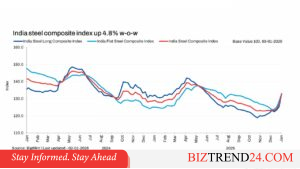
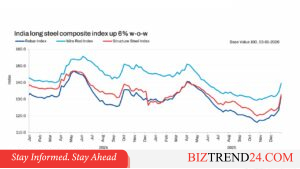
The flat steel index increased by 3.4% w-o-w, while the longs index saw a far sharper weekly rally of 6%, as per data.
Steel prices witnessed a year-end rebound which is continuing into the New Year, and the reasons are not far to seek: a) affirmative policy action in the form of the safeguard duty implementation; b) continuous rise in domestic iron ore prices, as well as firm imported coking coal prices; and c) mills fighting to secure margins amid rising costs and recover lost ground, with steel prices having dropped to five-year lows in 2025.
Highlights of price movements:
Primary mills hike rebar prices: The Tier-I mills increased rebar prices by up to INR 2,000/t during the last week of December, sources informed BigMint. Trade-level BF rebar prices surged w-o-w by INR 2,900/t to INR 51,900/t exy-Mumbai, as per BigMint’s assessment on 2 January. Prices are exclusive of GST at 18%. Strong bookings last week supported market sentiment and prompted price hikes, with several mills facing substantial order backlogs for the coming days.
Inventory levels at primary mills continued to decline, falling by around 25-30% in end-December compared to the middle of the month.
IF rebar surges: On a weekly basis, induction furnace (IF) rebar prices witnessed increased in the range of INR 1,500-4,300/t across regions last week. IF rebar market sentiment remained positive, with inquiries heard in key regions, though buying interest was seen adjusting to higher price levels. Order bookings improved selectively as buyers calibrated procurement strategies amid rising offers. Mills has no inventory pressure and filled with bookings for 15-20 days varying as per location.
Mills raise HRC, CRC list prices again: Leading Indian steelmakers raised list prices of hot-rolled coil (HRC) and cold-rolled coil (CRC) again by INR 750/t on 30 December after increasing them by 750-1,000/t in mid-December.
BigMint’s benchmark assessment (bi-weekly) for HRC (IS2062, Gr E250, 2.5-8 mm/CTL) climbed by INR 2,000/t ($22/t) w-o-w to INR 51,000/t ($566/t) on 2 January against INR 49,000 ($544/t) on 26 December.
Additionally, CRC (IS513, Gr O, 0.9 mm/CTL) prices increased by INR 1,900/t ($21/t) w-o-w to INR 57,600/t ($639/t) on 2 January against INR 55,700/t ($618/t) the week before. These prices are ex-Mumbai for the distributor-to-dealer segment and exclude 18% GST.
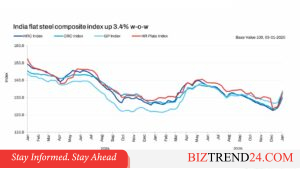
HRC and CRC trade markets moved sharply higher last week underpinned by mill price hikes and elevated raw material costs during the year-end holiday period. Distributors reported moderate inventory levels, while market sentiment turned bullish. Mills are eyeing another round of hikes this week.
Outlook:
BigMint estimates that after the implementation of the 12% safeguard duty landed costs of imports from both FTA and non-FTA countries will be around INR 5,000/t higher than current domestic HRC prices. Therefore, imports have been rendered unviable to an extent, thanks to the duty. This will doubtless offer mills the space to hike prices further in January.
On the other hand, BF-based producers are also looking to hike rebar prices further on expectations of a solid demand environment in Q4 of the fiscal, traditionally a peak season for demand. Strong domestic iron ore prices will offer ample support, no doubt. Add to that typical fourth-quarter worries pertaining to weather disruptions affecting coking coal supplies and prices.
While these present an upside, continuous price surges are likely to impact buyer behaviour despite the expectation of quicker inventory drawdowns compared to November and December of last year.